January 07, 2026
Work isn’t Working According to EX Trailblazer Nadin

There’s a growing crisis in UK workplaces that most politicians don’t see. While MPs debate future skills and employability, they’re missing what’s happening right now: work simply isn’t working anymore.
At the end of last year I sat down with the Chief Innovation Officer of Benifex, and winner of the EX Trailblazer Award at the EX Awards 2025, Gethin Nadin.
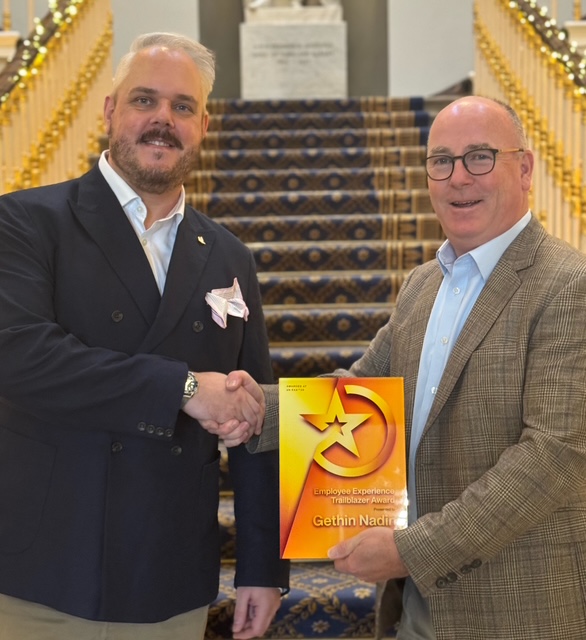
Nadin is a workplace wellbeing expert who’s spent nearly two decades in the field, has watched this crisis unfold. But unlike most commentators, he’s done something about it—creating a Policy Liaison Group for Workplace Wellbeing (PLGWW) that brings employers directly into Westminster to reshape how government thinks about work.
The Numbers Don’t Lie
The UK has the lowest productivity levels of any OECD country. We’re the only nation that hasn’t officially recovered from the 2008 financial crisis. Mental health issues in the workplace are rising. Overlay these trends, and the connection becomes clear: as wellbeing declines, so does productivity.
But here’s the gut punch, minimum wage in 2008 could buy you 14 cans of Heinz baked beans per hour worked. In 2025? Seven cans. Your money’s gone half as far, and most people should be earning at least 20% more than they currently are just to keep pace with the cost of living.
“My father worked in the prison service while my mum worked part-time,” Nadin explains. “They raised three kids, drove a car, paid off their mortgage before retirement, and my dad has a final salary pension. How many people these days, earning not-that-great money, are going to be able to do that?”
It’s not just nostalgia. It’s mathematics. And it’s affecting how an entire generation views work.
Flipping the Traditional Model
When Nadin was first invited to speak at an All Party Parliamentary Group on employability, he noticed everyone was focused on the future. They were discussing what skills people would need, how to get kids into STEM, whilst ignoring the glaringly obvious. Work isn’t delivering for people now, let alone what might happen in the future.
He took the opportunity to make a blunt point that work wasn’t working for people in the UK. The evidence was clear. Austerity, the cost of living crisis, and the pandemic had compounded to create a situation where “people don’t see themselves having long term careers. There’s a growing movement of people that work to fuel their personal interests outside of work and their job doesn’t form part of their identity.
Nadin decided that to create meaningful changes employers needed to get involved in the conversation. Instead of MPs inviting experts to speak, why not have employers lead the conversation with MPs as guests? If government wants businesses to change, it needs to understand what businesses actually need to make those changes possible.
Thus, the Policy Liaison Group was born—employer-led roundtables where real business owners, not just big employers like Sainsbury’s and John Lewis, could tell policymakers what would actually work.
“We need different perspectives from different regions to make this work. For example, if you’re a 50-person finance company, not based in London, what does work look like for your organisation?” Nadin asks. “We are getting those voices in the room.”
Building Credibility Takes Time
The PLG has now held ten roundtables covering everything from women’s wellbeing to the Employment Rights Bill, with support from organizations like CIPD, Acas, TUC, Business for Health, and the Royal Society of Public Health. MPs like Dr. Rebecca Cooper attended the women’s wellbeing session and immediately wrote to the government’s Minister for Equalities saying, “There’s this group saying important stuff, and we should be paying attention.”
It appears to be working. Elements from PLG discussions made it into both the Employment Rights Bill and the Charlie Mayfield’s ‘Keep Britain Working’ review. “You can’t draw direct lines,” Nadin admits. “But we know this information was talked about in rooms we were in, and that was used to inform policy.”
The group now has regular parliamentary engagement, with several MPs and peers attending consistently.
The Financial Wellbeing Focus
For 2026, the PLG is laser-focused on financial wellbeing and the research behind this focus is compelling.
Getting employees to save just £1,000 improves their overall wellbeing dramatically. They worry less about money, handle stress better, and mental health issues decline. Even increasing someone’s savings by just £250 improves workplace productivity by 25-30%.
When you have £1,000 saved, you gain something more valuable than money, you gain options. You can leave a terrible employer. You can move out of problem housing. You can make decisions based on what’s good for you, not just what you can afford.
“It’s the number one reason people say they don’t sleep in this country—worrying about money,” Nadin notes. “It’s one of the top two reasons behind divorce. We can link worrying about money to a drop in IQ, presenteeism, and absence rates.”
“If you create a Venn diagram of social wellbeing, mental health, and physical health, you could put financial wellbeing in the middle, and it affects everything,” he explains.
Employees are calling in sick because they can’t afford the commute under return-to-office mandates. Or conversely, they’re coming into the office specifically because there’s free food, and it means they don’t have to eat that evening.
The Leadership Challenge
The other major focus area is leadership quality—particularly crucial as most under-25s say they don’t want to be managers.
“Your line manager has a bigger impact on your overall wellbeing than your husband, wife, or doctor,” Nadin explains. Yet we blame managers for bad outcomes without supporting them properly.
The connection to financial wellbeing comes full circle here. If managers are worried about money, they can’t be good leaders. If employees see no financial incentive or security in management roles, they won’t pursue them. The system is eating itself.
Duty of Care Guidelines Coming in 2026
The PLG aims to publish duty of care guidelines in early 2026—defining the minimum level expected of employers to look after employee wellbeing.
“We’re designing it almost for SMEs,” Nadin says. “If you’re a 10-person hairdresser, how can you look after the wellbeing of your staff if you don’t have any money to go and buy stuff? What does that look like? These are the questions we are asking.”
The answer, he believes, lies in organizational design rather than purchasing perks. It’s about managers having appropriate conversations with employees. It’s structural, not transactional.
The Customer Service Connection
The through-line connecting all of this—employee experience, financial wellbeing, good leadership, and successful business outcomes—is customer service.
Nadin recalls judging an employee experience award where Virgin Money won by giving employees £100 monthly to delight customers however they saw fit. Someone bought flowers for an elderly customer who had fallen in a puddle. Another ordered pizza for a customer who wouldn’t have time for lunch during their mortgage appointment.
“The person who helped that woman who fell in a puddle felt great as well,” Nadin notes. “There’s very few things the employer could have done that day that would have had the same impact. We know that doing good for other people makes you feel good.”
He experienced this himself recently at Frog in Covent Garden. As soon as he sat down for an anniversary dinner, there was a card on the table signed by all the staff. “It’s such an easy thing to do, but the employee responsible for that is somebody at store level going, ‘we need to do this for our customers.'”
Happy employees make happy customers. It really is that simple.
Yet walk into many establishments today and you would have a fair chance of encountering the opposite. Employees who just don’t care because they’re not cared for. Because work isn’t working for them.
What Business Leaders Should Do in 2026
For organizations wondering where to start, Nadin’s advice is clear. Stop throwing random perks at the wall to see what sticks. That means instead of pizza afternoons, occasional trips, hollow ’employee of the month’ initiatives, start making real investments in people.
Think about people as appreciating assets – Someone at two years of service knows your products, customers, and mission. Nadin notes, “Why does the retail market accept 60% turnover in staff? Why can’t someone make a career stacking shelves and see their way to management?”
Empower frontline employees – Empower staff to create remarkable customer experiences. When you trust people and give them autonomy, they feel invested. And when they feel invested, they invest in your customers.
Focus on financial wellbeing – Help people save that crucial £1,000. The productivity gains alone justify the investment, never mind the human benefits.
Support your managers – They have more impact on employee wellbeing than spouses or doctors. If they’re struggling, everyone below them struggles.
Looking ahead, the question isn’t whether it’s worth it. It’s whether we can afford not to do it. As Nadin’s father discovered with his simple spreadsheet comparing baked beans prices across decades, the numbers tell a story politicians need to hear. And now, finally, some of them are listening.