
February 04, 2026
Innovation, Service, and the Student Journey at the Royal College of Art
What does great customer experience look like in higher education — especially in a world shaped by post-pandemic realities, rapid technological change, and rising student expectations?
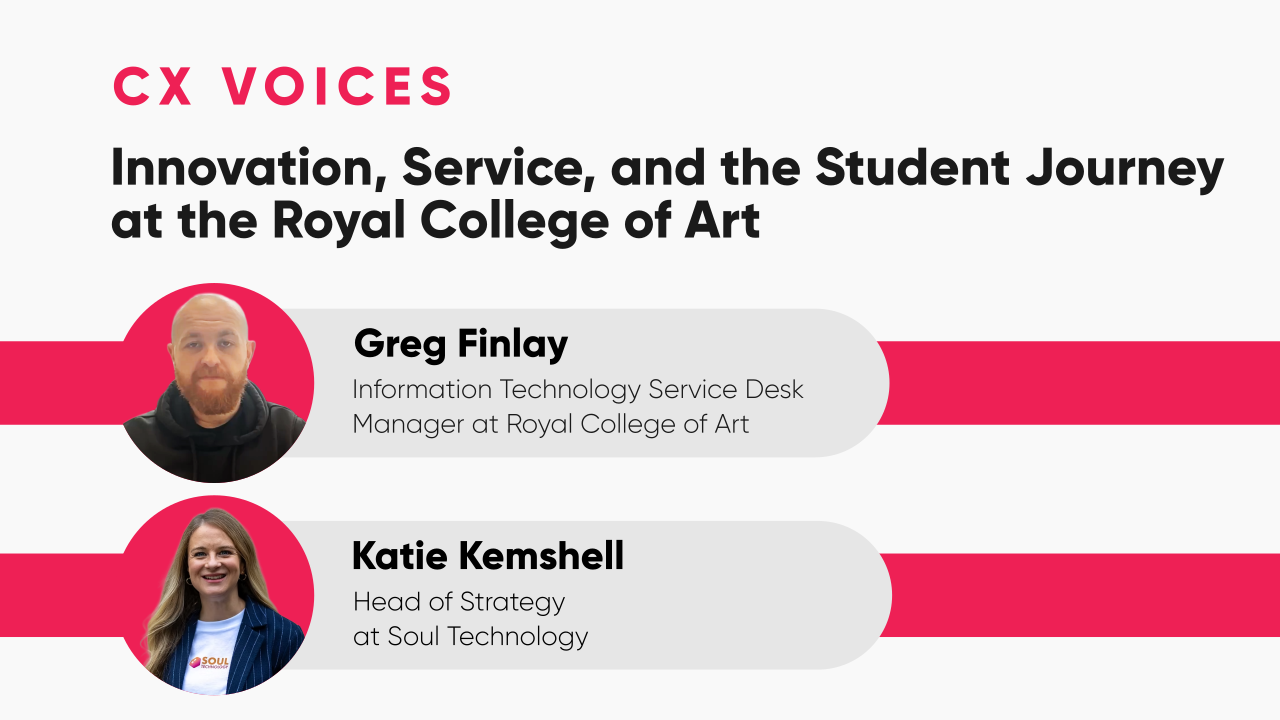
In this episode of CX Voices, host Katie Kemshell is joined by Greg Finlay, IT Service Desk Manager at the Royal College of Art (RCA), to explore how technology, culture, and mindset come together to shape meaningful student experiences — and why experimentation, even when it fails, is a vital part of that journey.
Seeing Students as Customers — and People
Greg’s role at the RCA goes far beyond traditional IT support. Serving staff, students, applicants, and alumni across three London campuses, his team supports everything from hardware and software to applications, networks, and emerging technologies. But the real differentiator is not the tools — it’s the perspective.
Rather than focusing on isolated moments of support, Greg frames his work around the entire student lifecycle — from the first enquiry, through enrolment and study, all the way to alumni support years after graduation.
This holistic view recognises that technology is not just an operational function; it’s a foundational part of how students experience their education.
A Unique and Diverse Customer Base
With schools spanning Architecture, Arts & Humanities, Communication, and Design, the RCA’s student body is diverse, international, and creatively driven. There is no “typical” customer — and that presents both opportunity and complexity.
As Greg explains, supporting a games designer, a painter, a service design researcher, and a visiting academic all through the same service model requires flexibility, empathy, and a deep understanding of how people actually work — not just how systems are designed to work.
Experimentation, AI, and the Freedom to Fail
One of the most compelling parts of the conversation focuses on a recent project exploring the use of an AI chatbot to expand self-service support across the institution.
On paper, it seemed like a simple, low-cost innovation. In practice, it became a powerful learning experience.
While the proof of concept never reached full live deployment, the project revealed critical insights:
- Technology solutions must be designed across disciplines, not in silos
- Users will bring all kinds of needs to a single interface — not just the ones you expect
- Cultural readiness matters just as much as technical capability
Most importantly, the RCA’s culture allowed the project to be viewed not as a failure, but as progress.
As Greg puts it, innovation only works when organisations are willing to test, learn, adapt — and try again.
Human-First, AI-Supported
Rather than chasing AI for its own sake, the RCA takes a grounded, human-centred approach. Greg describes their philosophy as a human-and-AI hybrid, where technology supports creativity, research, and service delivery — without replacing human judgement or empathy.
Whether through conversational AI, data analysis, or future agentic tools, the goal is always the same:
to empower people, not overshadow them.
Lessons for Higher Education and Beyond
For universities and colleges considering similar technologies, Greg offers clear advice:
- Understand what your customers are actually doing
- Avoid narrow solutions that don’t reflect real behaviours
- Involve diverse stakeholders early
- Design for integration, not isolation
- Accept that meaningful innovation includes risk
Technology teams, he argues, can no longer sit “in a locked cupboard plugging in cables.” Today, IT is about people first, service design, and experience leadership.
Be Part of the Student Experience
Greg’s closing message is simple — and powerful.
Embed yourself in the student experience. Listen. Participate. Attend forums. Learn directly from users. And if possible, become a student yourself.
Because when you understand the journey from the inside, you design better systems, deliver better services, and create experiences that genuinely support learning, creativity, and growth.