
February 24, 2026
Inspiring Citizen CX for Medway Council
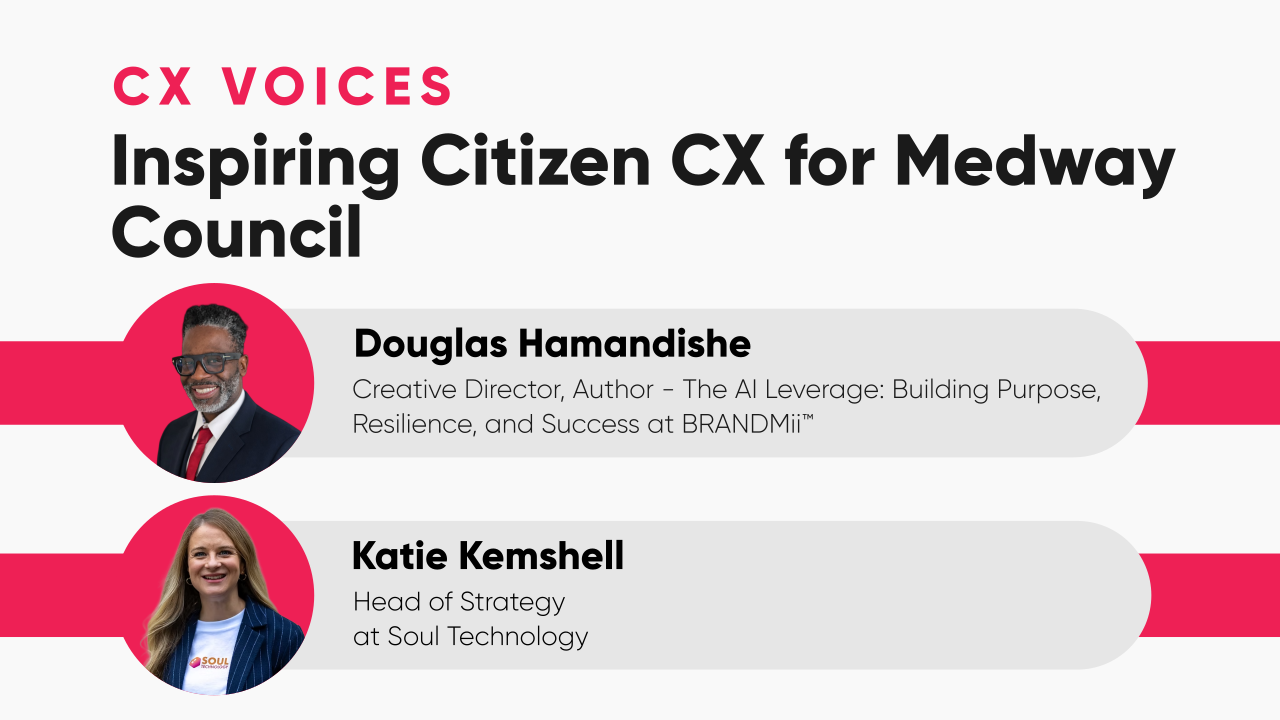
Digital transformation in public services is often sold as a productivity problem — reduce costs, increase throughput, automate the rest. But as former Deputy Mayor of Medway Douglas Hamandishe makes clear, that framing misses the point entirely. The real challenge facing councils isn’t efficiency. It’s trust.
Hamandishe spent his time in the mayoral office doing something deceptively simple: making sure residents knew where they stood. Every email that came in, every request for help, was an opportunity either to acknowledge a person or to lose them. “We recognise that when people take the time out to format an email requesting assistance,” he explains, “they want to know what happens next.” That awareness — that behind every query is a human being who has invested time and hope — shaped how the office operated.
See the full episode here
The Paradox of Speed
One of the sharpest insights Hamandishe offers is the paradox between efficiency and feeling heard. Speed of service and quality of engagement aren’t the same thing, and conflating them is where many councils go wrong.
His analogy is a GP appointment. You might be seen in five minutes, but if the doctor seems distracted, doesn’t acknowledge your concerns, or rushes you out the door, you leave feeling worse than when you arrived. “People forget how fast the service is,” he says. “People remember the quality of engagement.” The same logic applies to councils. A resident who waits fifteen minutes but feels genuinely listened to will walk away with more trust in their local services than one who gets an instant automated response that doesn’t actually address their concern.
This isn’t just anecdotal. Hamandishe points to resident surveys that consistently show people are willing to wait — provided they’re kept informed and treated with respect throughout the process.
The Administrative Black Hole
The scenario that best captures the trust problem is the pothole report. A resident spots a pothole on their way to the school run. It’s raining. They pull over, note the road name, estimate the size of the crater, try to navigate a council website that asks questions they can’t answer while standing in the cold — and then, if they manage to submit anything at all, they hear nothing back. No acknowledgement. No update. No indication that anyone received the message, let alone that anything will be done.
Hamandishe calls this the “administrative black hole — where all emails go to die.” What goes in doesn’t come out. The opacity becomes so complete that the resident is left with nothing: no information to share, no confidence that they’ve been heard, and one more reason not to bother next time.
The frustrating part, he notes, is that this isn’t a resource problem anymore. “Technology has never been cheaper to deploy,” he says bluntly. The barrier isn’t infrastructure — it’s ambition, and the willingness to put residents first rather than process metrics.
What AI Can Actually Do
Hamandishe is not opposed to technology. He has written extensively on AI adoption and sees genuine potential in it. But he is clear-eyed about where councils tend to go wrong. Too often, AI is deployed as a cost-cutting measure rather than a service improvement. A chatbot that leads to a dead end, or an automated system that can only handle one issue at a time, doesn’t reduce resident frustration — it deepens it.
His counterargument is that, when used well, AI should do the opposite. It should remove friction, handle the repetitive and administrative work that doesn’t require human judgment, pre-qualify requests so residents aren’t passed back and forth between departments, and give people visibility into where their query actually sits in the process. The flight tracker analogy is instructive here: as a passenger, you can’t make the plane go faster, but knowing your arrival time and making your journey comfortable change the entire experience. Councils could offer something similar — and largely don’t.
The problem, as he sees it, is that too many organisations reach for technology before asking what they’re actually trying to change. “What process were you trying to change using technology, and why are we changing it?” he asks. “Because if you cannot improve it, there’s no point in bringing the technology.” Deploying AI on top of a broken process doesn’t fix the process — it just makes the same failure happen faster and at greater scale.
Trust Is Built Slowly — and Broken Quickly
Perhaps the most sobering part of this conversation is Hamandishe’s assessment of what happens once trust is lost. It spreads fast — bad experiences shared between neighbours, families, colleagues. And rebuilding it is slow, difficult work that requires honesty, transparency, and a willingness to admit that previous approaches fell short.
Some councils, he observes, respond by rebranding departments, shifting responsibilities, or changing the name of a service as though residents won’t notice. They do notice. The memory of a failed chatbot, an unanswered email, or a complaint that disappeared into a system with no response doesn’t fade quickly — especially when council tax is still being paid.
His advice is to do the hard work upfront. Test rigorously and for long enough, with real people in real scenarios rather than clean test environments. Bring residents into the design process — through pop-up consultations on the high street if necessary. Choose the long road that leads somewhere rather than the short road that leads to re-engineering, lost trust, and the same problems resurfacing.
The Bigger Picture
What this conversation ultimately points to is a question of institutional identity. Councils are not simply service delivery machines — they are the closest point of contact between the state and the individual. The experience a resident has reporting a pothole or chasing a missed bin collection shapes how they feel about the institutions that govern their daily life. That experience is political in the most direct sense.
Hamandishe’s closing challenge is simple: AI doesn’t have to be cold. Used with care and genuine intent, it can reassure, inform, and give residents back something they rarely feel public services offer — their time, and the sense that someone is actually paying attention.