
June 30, 2026
Inside CX Vision 2035: Tackling Finance Transformation and the Work-Design Crisis
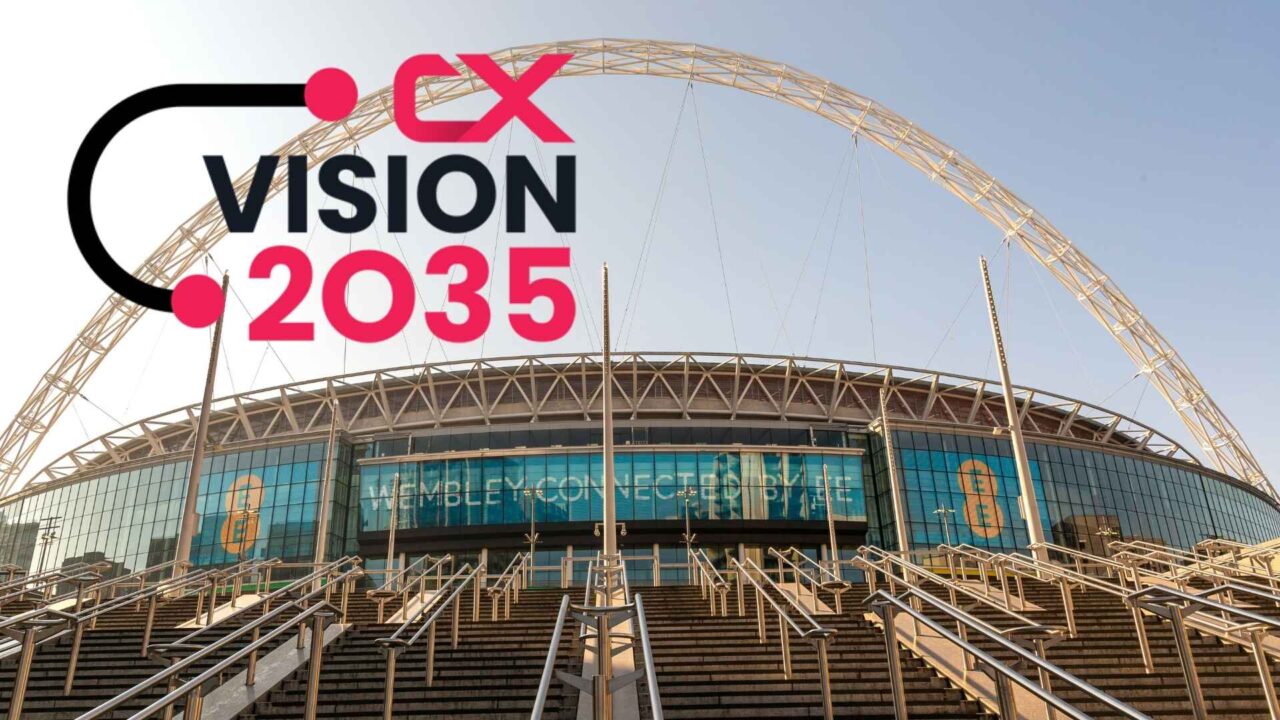
Two sessions at the CX Vision 2035 – Wembley Stadium on 5th November 2026 – reveal why the most important questions in customer experience are no longer about technology — they’re about how organisations actually work.
What are the most important sessions at CX Vision 2035? That depends on where your CX strategy is stuck.
If it’s stuck because the internal operating environment is quietly undermining every initiative before it reaches the customer, the Justin Robbins workshop will give you a framework to fix that in 30 days. If it’s stuck because you’re watching financial services overtake your sector in experience quality and want to understand how that happened, the Ian Golding-chaired finance panel will explain it through four very different institutions in four very different markets.
Both sessions take place at CX Vision 2035 — a one-day leadership summit at Wembley Stadium in London on 5 November 2026, bringing together 2,500 senior CX professionals to address what customer experience strategy should look like over the next decade.
Workshop: Lift, Lower, Lock, and Lean — Redesign Work So People Stop Pulling Back Justin Robbins, CEO, Metric Sherpa

Why are CX teams struggling with engagement? Justin Robbins, CEO of Metric Sherpa, argues the answer isn’t what most leaders expect.
Most conversations about disengagement start with the individual — their motivation, commitment, and attitude toward the work. The diagnosis is usually framed as a mindset problem. The prescription is usually a cultural programme. And the cycle repeats because neither addresses what is actually happening.
Robbins starts somewhere different. In this CX Vision 2035 workshop, disengagement is treated as a work-design problem. Not a personal failing. Not a generational quirk. A rational response to a system that has been teaching people, gradually and consistently, that protecting their energy is the sensible thing to do.
The argument is hard to dismiss once clearly defined. When priorities shift every week, when approvals crawl, when the values on the wall contradict the dashboards on the screen, and when every incoming request arrives marked urgent — pulling back isn’t apathy. It’s self-preservation. The people haven’t changed. They’ve adapted to the environment you built around them.
The framework Robbins uses is structured around four forces: what in your current setup lifts people’s capacity to do meaningful work; what genuinely lowers friction rather than redistributing it; what locks people into playing small, performing compliance, or managing perception rather than outcomes; and what creates the conditions that invite them to lean back into effort that actually matters.
What separates this from a typical conference keynote is what happens in the room. Through focused diagnostics and guided table work, delegates choose one specific pattern from their own organisation — a meeting rhythm, an approval chain, a reporting dynamic — and rebuild it on the spot. The output is three concrete actions, ready to launch within 30 days, each with a direct line drawn to measurable CX and employee experience outcomes.
Robbins also builds in a cadence for keeping the framework alive — embedding Lift, Lower, Lock, and Lean into huddles, one-to-ones and leadership meetings so it becomes a repeating diagnostic lens rather than a one-off workshop exercise.
For CX and operations leaders asking why transformation programmes stall between strategy and execution, this session points directly at the answer. The organisations seeing genuine traction on CX transformation share a common characteristic: the internal operating environment reinforces the behaviour the customer strategy requires, rather than working against it. This workshop is one of the most practical sessions on the CX Vision 2035 agenda for closing that gap.
Panel: Finance — Global Banking, Local CX How Finance Became a Frontline for CX Transformation
Host: Ian Golding | Panellists: Scott Lee Holloway, APS Bank; Özgecan Dabanca, Aktif Bank; Claire Bristowe, Aegon; Shorouk M. Ali, Bouyan Bank
How did financial services become a CX leader? For years, the sector was the cautionary tale the rest of the industry pointed to. Heavily regulated, structurally conservative, and historically more focused on risk management than relationship design, banking sat near the bottom of most experience benchmarks — and appeared largely comfortable with that position.
That story is now over. In the last five years, financial services have become one of the most competitive arenas in customer experience globally. Challenger banks, mobile-first expectations and an increasingly sophisticated customer base willing to switch providers for a better interface forced a sector-wide reckoning. The institutions that responded are now producing some of the most compelling CX work in the global economy. Those who haven’t are losing ground.
This CX Vision 2035 panel brings together four senior leaders from financial institutions operating in very different markets and under very different pressures — hosted by one of the most respected independent CX practitioners in the world.
Scott Lee Holloway of APS Bank brings the perspective of a full-service institution in the tightly regulated Maltese market, navigating the challenge of modernising customer experience while maintaining the trust earned over decades of established presence. Özgecan Dabanca of Aktif Bank represents one of Turkey’s most dynamic financial institutions, operating in a market where digital adoption has accelerated rapidly, and customer expectations have outpaced many established players. Claire Bristowe of Aegon adds the insurance and long-term savings dimension — where the CX challenge is distinctly different: building meaningful relationships across products, customers rarely think about until the moment they need them most. Shorouk M. Ali of Bouyan Bank brings a Gulf perspective from a region where national transformation agendas and a young, digitally native population have created both enormous opportunity and significant design complexity.
The conversation will move across the fault lines defining CX in modern finance: the tension between global operating models and genuinely local expectations; regulation as both a constraint and an unexpected catalyst for experience design; whether trust is inherited or must be actively rebuilt; and what the next decade demands from institutions that spent the last one catching up.
What makes this panel worth prioritising is the range it represents. Four institutions. Four markets. Four versions of the same fundamental challenge. For CX leaders outside financial services, the transferability is high — any organisation operating across regulated, complex, multi-market environments will find more directly applicable insight here than in many sessions nominally aimed at their own sector.
Why These Sessions Belong in the Same Conversation
What connects the Robbins workshop and the Golding-chaired finance panel is the question underneath both: is your organisation actually built to deliver on its CX ambitions, or is the internal architecture working against them?
Robbins addresses the operating environment — the rhythms, structures and design choices that either enable people to do their best work or teach them to pull back. The finance panel demonstrates what happens when external pressure forces an entire sector to answer that question honestly and at speed. Together, they make the case that the most consequential CX questions heading into the next decade are not about which platform to invest in or which metric to optimise. They are about whether the organisation behind the strategy is genuinely capable of executing it.
Stay tuned for more speaker updates.
Sign up here – CX Vision 2035. 5th November 2026. Wembley Stadium, London.