
June 26, 2026
Salesforce Unveils Help Agent With Outcome-Based Pricing, Only Gets Paid When Its New AI Works
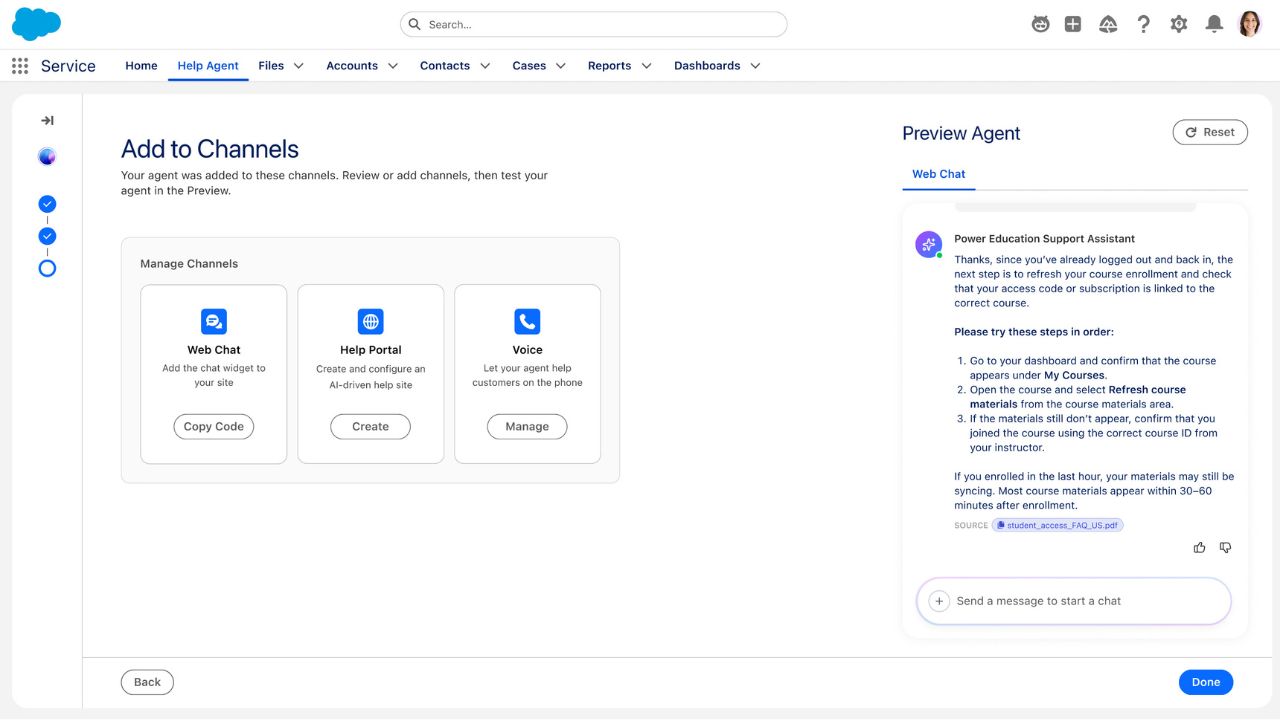
Salesforce has launched Agentforce Help Agent, a pre-packaged autonomous customer service agent that organisations can deploy across voice, web, portal, and messaging from a single setup screen. Interestingly, customers will only pay, under a new pricing model, when it resolves a customer issue without human intervention. The price is a flat $2 per autonomous resolution.
The agent is built on the Agentforce 360 Platform and arrives pre-configured. It connects automatically to Salesforce Knowledge, which Salesforce identifies as the most common reason AI agents underperform: poor or incomplete data producing unreliable outputs. Organisations can supplement this by uploading files or entering a URL for the agent to crawl. A built-in preview pane allows teams to test responses before going live.
Kishan Chetan, EVP and GM of Agentforce Service at Salesforce, commented:
“Built on our deeply unified, secure-by-design platform, it delivers a personalized, proactive omni-channel experience that is even easier to set up. And with our pay-per-resolution pricing, our success is directly tied to our customers’ success.”
Out of the box, the Help Agent handles customer questions and case management. Additional capabilities, such as order management, appointment scheduling, and account management, can be added via Agentforce Builder or a third-party coding tool. The Agentforce Customer Service Portal has been redesigned around a single conversation interface. It surfaces relevant responses and task-completion options inline and draws on live data to engage customers proactively where needed.
Both the Help Agent and the new pricing model are generally available from July 2026.
No Resolution, No Charge With Agentforce AI Customer Service
If a customer requests a human agent or abandons the interaction unsatisfied, there is no charge. Both Data 360 and Agentforce remain unmetered during the interaction itself. The pricing sits alongside Salesforce’s existing models, which are per conversation, per action via Flex Credits, and per-user licensing, all of which remain available. However, the new pricing is fundamentally different in kind. The charge is tied to an outcome rather than to activity or access.
The numbers Salesforce cites come from its own support operation. The company says it has handled 4.3 million enquiries through help.salesforce.com and resolved 70% of them autonomously. That is the proof of concept behind the commercial model, and the basis on which Salesforce has decided that charging per resolution is viable at scale.
Early enterprise deployments are generating comparable results. Fisher & Paykel, the appliance manufacturer, reports that agentic AI has already doubled its self-service resolution rates. In the UK public sector, Thames Valley Police and Hampshire & Isle of Wight Constabulary have deployed an AI assistant called Bobbi for non-emergency enquiries. Tom Kempster, Director of Digital and Innovation at Thames Valley Police, reported that “between 70 to 75% of those contacts Bobbi is handling fully autonomously.” These figures carry more weight given the accuracy and public accountability demands of a policing context.
Alongside the product launch, Salesforce recently signed a definitive agreement to acquire Fin for approximately $3.6 billion. Fin brings 30,000 customers and a proprietary model built for support use cases. Salesforce reports it closes around 76% of requests without human intervention. Where Help Agent is designed for enterprise deployments within the Salesforce ecosystem, Fin is packaged for fast deployment with minimal configuration. This covers organisations that need resolution capability quickly and sit outside the Salesforce stack. The deal is expected to close in Q4 of Salesforce’s fiscal year 2027.
Why the Market Is Paying Attention
Arguably, what’s essential here is less about the product features and more about what the pricing model signals.
According to Futurum Group’s 1H 2026 Enterprise Software Decision Maker Survey of 830 respondents, 18.7% of enterprises now use outcome-based pricing tied to agreed metrics. This is a share that has been climbing. When a vendor with Salesforce’s scale and installed base formalises the model for customer service, it raises the bar for the category. Competitors relying on seat or consumption pricing without outcome guarantees will face harder questions from buyers who now have a concrete alternative to hold up.
It also responds to a problem Salesforce has been candid about. The large majority of enterprises investing in AI are not yet seeing a return. The Help Agent is partly an attempt to lower the implementation barrier enough that more organisations can reach a live deployment. They can also find out whether agentic AI actually works for their customer base, rather than staying stuck in pilots.
What Buyers Should Consider Around Agentforce’s AI Help Agent
The 70% resolution rate is Salesforce’s own figure from Salesforce’s own deployment, on Salesforce’s tech, with Salesforce’s data. It is a useful reference, not a guaranteed baseline. Organisations with legacy systems or fragmented data should factor in a gap between that benchmark and their own initial results. As a result, they can build a realistic implementation plan before committing.
There is also the definitional question to factor in. Pay-per-resolution charges when an issue is closed without escalation. It does not, by default, account for whether the resolution was accurate. In regulated industries, such as financial services, utilities, and healthcare, procurement teams should potentially seek contractual clarity on how resolution is defined, how disputes are handled, and what audit mechanisms are in place before treating the pricing model as fully risk-aligned.
It is worth noting that Help Agent is not a standalone product. It requires an existing Salesforce foundation, including Service Cloud, Data Cloud, and Salesforce Knowledge. For organisations already in that ecosystem, the deployment case is clear. For those outside it, that is a different conversation entirely.