
July 23, 2026
The Five Foundations of Psychological Safety: Helen Sanderson on EX Lore Podcast
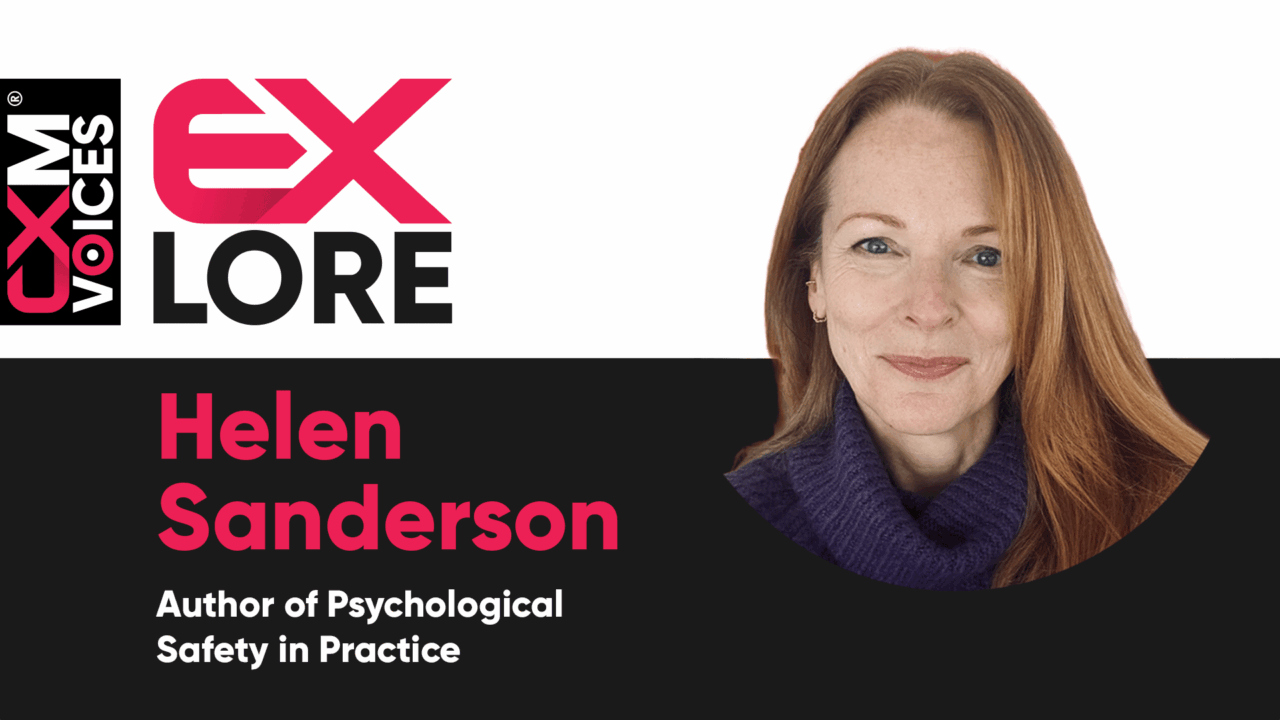
You cannot announce psychological safety into existence, and yet leaders keep trying to.
In the latest episode of EX Lore, a podcast from Customer Experience Magazine, guest Helen Sanderson recalls sitting in a meeting where the facilitator opened proceedings with: “I now declare this meeting psychologically safe.” It is a moment, she says, that shows how misunderstood the term has become.
Sanderson has spent 30 years as a consultant in health and care, and founded Wellbeing Teams, a provider organisation rated outstanding by the Care Quality Commission (CQC). Her new book, Psychological Safety in Practice, is out in October. Speaking to Becky Norman, EX editor at CXM, she explores how to embed the five foundations of psychologcal safety across the employee lifecycle.
Watch the full episode below or on Spotify.
You Cannot Declare Psychological Safety
“You can’t just declare psychological safety, nor can you have a psychologically safe organisation, because it’s something that’s created team by team,” Sanderson says. It has to be built through what she calls five foundations: mattering, clarity, voice, connection, and learning.
Each one, she argues, translates into a specific question an employee is asking at any given moment: do I matter here, is it clear what is expected of me, is my voice welcome, do we understand each other, and do we turn experience into change.
Hiring and Onboarding: Showing People They Matter
Rather than treating psychological safety as an abstract cultural goal, Sanderson maps it onto specific, recognisable moments in the employee lifecycle.
Hiring is one of the first opportunities organisations tend to miss, she says, pointing to how traditional job descriptions often fail to give candidates real clarity about what is expected of them, or a sense that they matter as individuals before they have even joined.
Onboarding gets similar treatment. Sanderson describes the weeks between someone accepting a role and their first day as a critical, and often neglected, window.
At Wellbeing Teams, this period included a distinctive, low-cost gesture sent to new starters in the post, one that Sanderson says was designed to make people feel noticed by their new colleagues well before induction. “It’s not a massive investment, but it’s something that makes you go, it’s a wow moment,” she says.
Meetings as a Culture Microcosm
The conversation also turns to the most routine part of working life: meetings. “Meetings are a microcosm of the culture of an organisation,” Sanderson says, arguing that hierarchy, disorganisation or genuine collaboration all show up in how a meeting is run.
She points to structured agendas, rounds where everyone speaks in turn, and short check-ins at the start of a meeting as simple ways to build clarity and voice into a habit that most teams already have.
Supporting People Through Crisis and Feedback
The conversation turns to crisis and feedback, two situations many managers dread. On bereavement, she pushes back on a phrase most people reach for instinctively. “Something not to say is, I’m sorry for your loss, because that’s what everybody says,” she says. “It doesn’t make the person feel seen.”
She offers an alternative rooted in what she calls empathy guessing, along with a script for delivering difficult feedback without making it feel personal.
Leading Through Change
Sanderson closes with a warning for leaders navigating change. The mistake she sees most often is a failure of clarity about what has already been decided, what is still open to influence and when people will hear the outcome.
“Closing the loop in relation to clarity” is, in her words, where most communication efforts fall down.
Key Moments From the Conversation
- The meeting that was “declared” psychologically safe, and why that approach fails.
- The five foundations of psychological safety: mattering, clarity, voice, connection, and learning.
- A simple way to turn traditional job descriptions into clearer role definitions.
- The unconventional gesture Wellbeing Teams used to welcome new starters before their first day.
- Practical changes to meeting structure that build trust without adding time.
- The phrase to avoid with someone experiencing bereavement, and what to say instead.
- A script for giving difficult feedback without damaging the relationship.
- The one mistake leaders consistently make when supporting employees through change.
To hear the full conversation with Helen Sanderson, and more episodes exploring what it takes to build a better employee experience, subscribe to EX Lore on Spotify and YouTube.
 Your Employee Experience Roundup: Microsoft’s AI Findings, Deloitte’s Two-Tier Benefits Controversy, and ServiceNow’s Autonomous HR Push
 Your Employee Experience Roundup: The AI Efficiency Pushback, Forrester’s Sobering EX Data, and 61% Cover Their Backs At Work
 What the Workday Ruling Means for AI Hiring Discrimination