
June 15, 2026
New 8×8 Capability Lets Contact Center Agents, Customers Speak Different Languages on the Same Call
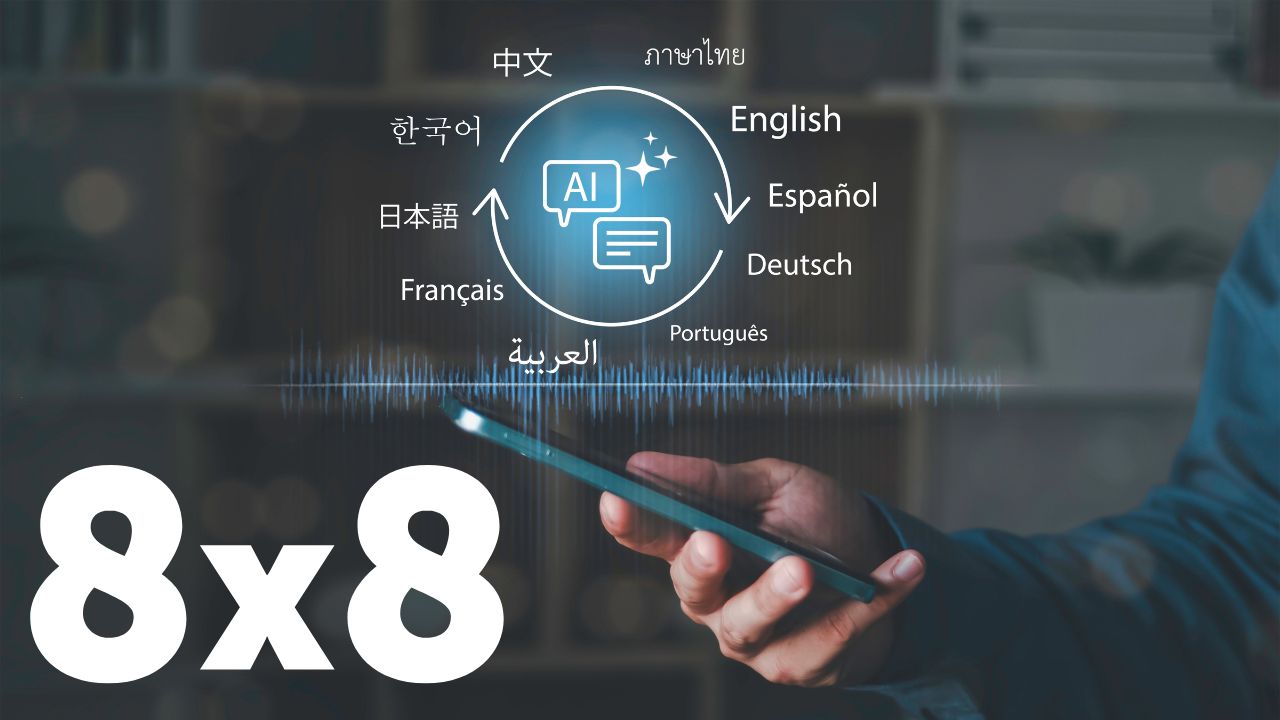
When a customer phones a contact centre in a language the agent doesn’t speak, the usual outcomes are a transfer, a callback, or an abandoned call. 8×8 is endeavouring to cut that short, introducing live simultaneous voice translation to its 8×8 AI Studio platform.
This empowers agents and customers to hold a conversation in different languages without either party switching channels or waiting for a human interpreter. The feature covers 13 languages and is currently in early availability.
The experience works by playing a softened version of the customer’s original voice beneath a real-time AI-generated translation. As a result, the agent hears both the customer’s tone and the translated content simultaneously. The same process runs in reverse. Neither party needs to pause or repeat themselves; the call simply continues.
How 8×8’s New AI Voice Translation Feature Works Behind the Scenes
Translation runs natively inside 8×8 AI Studio’s voice agent and advisor experience. There is no separate interpretation service to connect, and no changes to existing workflows. The system detects a language mismatch automatically, and translation begins. Both the original speech and the translated output are captured in the call record. Supervisors reviewing sessions can access both.
That audit trail will matter to contact centres in regulated industries. A translated interaction that cannot be independently reviewed creates compliance risk, but the ability to replay both versions removes that concern.
Emil Ivov, VP of Product for Video Platform and Services at 8×8, commented:
“I’ve spent much of my life living abroad, and I know from experience how isolating a language barrier can be. As an international student in France, even simple tasks like contacting a service provider or calling customer support could feel overwhelming.”
The accuracy of the translation builds on 8×8’s recent integration of OpenAI’s GPT-Realtime, which improved transcription of accented and non-native speech. That foundation is critical. A translation system is only as reliable as its ability to correctly hear what was said in the first place.
Live translation is the latest in a run of capability additions to 8×8 AI Studio since the platform launched earlier this year. Others include selectable AI models, such as Claude, Gemini, Grok, and ChatGPT, all available per agent. There are also one-click connectors to enterprise tools, including HubSpot, Slack, Stripe, and Atlassian, which is an IVR-to-AI conversion tool for contact centres migrating off legacy phone trees. Lastly, there is voice-driven agent building.
- 8×8 Launches Pulse to Turn Conversational Data Into Actionable Business Intelligence
- 8×8 Usage Revenue Hits Record High While AI Volumes Surge and Per-Seat Era Fades
The Market Behind the AI Voice Translation Capability
The demand for multilingual support technology is growing. According to a recent report from Market Intelo, the global multilingual customer support platform market was valued at $2.3 billion in 2024 and is forecast to reach $7.6 billion by 2033, growing at around 14% a year. This is driven largely by cross-border commerce and rising customer expectations around personalisation.
The existing solutions carry real costs. Mindstudio, an AI agent testing and deployment platform, suggests a specialist multilingual agent costs $15–30 per hour, depending on the market. That cost multiplies as organisations expand into new territories. Third-party interpretation services add both expense and friction. Neither scales particularly well.
“With real-time translation in 8×8 AI Studio, we’re helping organisations communicate with customers in their preferred language, making support more accessible, more natural, and more human,” Ivov added.
What It Means in Practice for CX and Contact Centre Leaders
For contact centre leaders, what’s notable is that a team of English-speaking agents can now handle calls from customers who speak French, Spanish, Japanese, or any of the other supported languages, without a specialist resource on standby. The interaction gets resolved rather than transferred or dropped.
The QA and compliance angle is worth flagging for operations and risk teams. Because both the original and translated audio are logged, the full interaction is reviewable. This is not always the case with third-party interpreter arrangements, where the contact centre may have limited visibility of what was actually communicated.
There is one gap worth noting for prospective buyers, however. 8×8 has not publicly specified which 13 languages are supported. That detail will obviously determine fit for many organisations, so it’s worth confirming directly before factoring into any procurement decision.