July 09, 2026
Microsoft’s AI Sales and Service Agents Leave the Lab and Clock In With General Availability
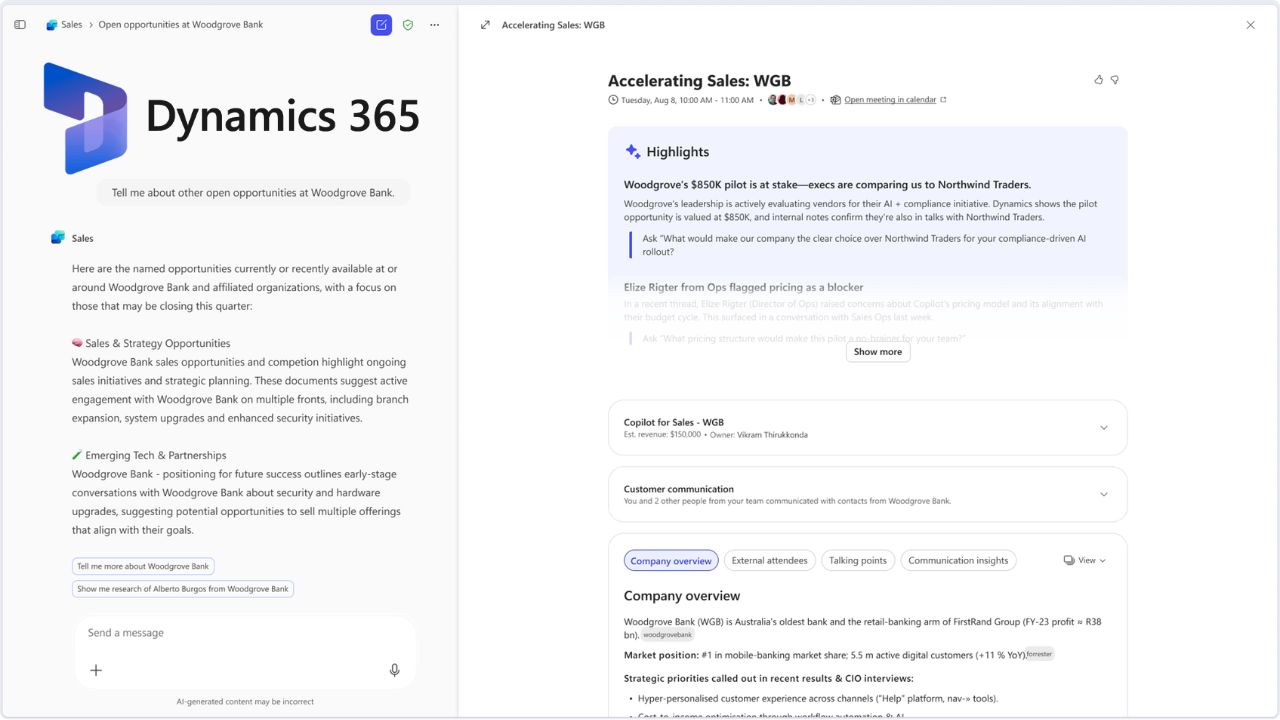
Microsoft has taken the wraps off its new Sales Agent and Service Agent solutions, confirming general availability across Microsoft 365 Copilot and Dynamics 365. Both tools have been circling in preview for months.
The pitch, in Corporate Vice President of Dynamics 365 Customer Experience Deva Rajamohan’s words, is that agentic AI belongs inside the tools people already use rather than bolted on beside them. Sales Agent pulls account history and deal context into plain-language chat wherever a seller happens to be working, whether in Dynamics 365, Outlook, or a Teams call. This means they’re not hunting through three systems before a customer meeting. After the call, it can log objections and next steps straight back into CRM fields.
Service Agent performs the equivalent for casework. It summarises a customer’s history, suggests next steps, and drafts the follow-up email. A human always approves.
Rajamohan wrote in the announcement blog:
“Powered by Work IQ and grounded in Dynamics 365 data, these agents understand real work patterns and act on the same customer data your business runs on.”
What’s New With the Agentic AI Products Versus What’s Just Renamed
Arguably, the most notable change is in the architecture rather than the cosmetics. Both agents run on Microsoft’s model context protocol foundation, and Copilot is now generally available directly inside Dynamics 365 Sales and Customer Service. This means the same agent behaves consistently whether someone’s working from the CRM or their inbox. It’s a minor but instructive illustration of how agentic AI customer service is transforming into something closer to shared infrastructure rather than a bolted-on extra.
There’s also a subtler announcement buried in her. There are now Cowork plugins that let the Sales and Service Agents work across a team rather than one seller’s inbox. They can support with coordinating a multi-stakeholder deal, or a case escalation that needs three departments to agree on something before Friday.
- Financial Cooperative Desjardins Gave Its Advisors a CRM Shared Memory With Microsoft Dynamics 365, and Customers Noticed
- Microsoft’s Copilot Learns to Finish the Job in Dynamics 365, Not Just Start It, With Service Agent and New MCP Tools Availability
The Numbers, and the Numbers Behind the Numbers
Microsoft leans on two outside figures to make its case. IDC found organisations getting $3.70 back for every $1 spent on generative AI. However, it’s worth knowing that Microsoft co-sponsored that study. This doesn’t necessarily make it wrong; it’s just worth reading with one eyebrow raised. Gartner’s own forecast for agentic AI in customer service is bolder still, though. It claims 80% of routine service issues will be resolved without a human by 2029, cutting operational costs by 30%. That’s a five-year horizon and an industry-wide projection, not a guarantee for any specific deployment.
Somewhere between those two sits the more modest, more believable figure. Sellers given AI-suggested next actions are 2.6 times more likely to hit growth targets, based on Gartner’s survey of 227 chief sales officers, fielded last autumn and presented in May. Behavioural nudge, not miracle cure.
What It Actually Means for Customer Service Once the Demo’s Over
For the people using this rather than buying it, the interesting bit is the admission, tucked neatly into Microsoft’s own post, that too much of a seller’s or service agent’s day still disappears into searching across systems. That’s an age-old problem wearing a new coat. Whether the Sales Agent fixes it will come down to something unglamorous. How tidy is the underlying CRM data already? How many extra clicks does a rep save on an ordinary Tuesday?