March 03, 2026
Chatbots vs Voicebots: The Conversations Customers Actually Want to Have
Customer experience is in a strange spot right now. People can get support faster than ever, but that doesn’t mean they’re happy. In fact, three-quarters of customers say AI gives them answers quickly, but they still leave the conversation frustrated.
There are a lot of reasons for this, but sometimes it comes down to something simple: companies didn’t choose the right type of bot in the first place.
The chatbots vs voicebots debate is awkward because it seems like a basic decision: text or voice? Text seems like the easiest option because chatbots are easy to build, implement, and use at scale. Voice is harder; there are more nuances to think about, from “tone of voice” to latency.
The important thing to remember is that if your AI system doesn’t fit the moment, it won’t work, regardless of how convenient it might seem.
Chatbots vs Voicebots: What’s a Chatbot?
A chatbot is just text trying to be helpful. You’ve seen them everywhere by now. Websites, apps, support pages. Most end up looking the same after a while.
Some are basically FAQs with a typing box. Others can pull in account info, suggest next steps, even guess what someone means when the wording’s a mess. They work when things stay simple. When something actually feels urgent or serious, people don’t usually sit there typing. Chat works when the stakes are low, and the answer isn’t up for debate.
Checking an order. Resetting a password. Updating an address. Asking for a product recommendation. That’s why chatbots scale so well for businesses; they’re a low-cost, efficient way to handle thousands of “low-tier” queries without hiring extra staff.
The Benefits and Limitations of Chatbots
The thing to remember here is that chatbots aren’t necessarily less advanced than voicebots. Some bots are surprisingly capable. They can pick up on nuance, stick to a brand’s tone, and suggest the right product without sounding forced. A few even take action, like submitting a refund or stepping through a fix instead of bouncing someone to a help article.
Plenty of companies see great results from these bots. Klarna’s AI assistant handled about two-thirds of customer service requests in the first month it was deployed: the same work as about 700 full-time employees.
Lightspeed pushed resolution rates past 60% when an Intercom chatbot handled the repetitive work and passed clean summaries to agents. WHOOP resolved 84% of sales conversations during a launch surge because chatbots handled the predictable questions and stepped aside when things got nuanced.
But chatbots are limited by design.
Where chatbots pull their weight
Chatbots work when the work itself is boring. When the task doesn’t require judgment. When nobody wants to talk for long.
They tend to do well when:
- The question shows up over and over again: Order tracking. Password resets. Delivery updates. The stuff agents can answer in their sleep.
- The outcome is obvious: There’s a correct answer, and it doesn’t shift based on mood or interpretation.
- Nobody expects warmth: Customers aren’t looking for empathy here. They just want the task finished.
- A short pause doesn’t feel rude: In chat, a few seconds of silence feels normal. Sometimes it’s even reassuring.
- Details need to be written down: Links, forms, and confirmation numbers. Text handles this better than memory ever will.
Where chatbots start causing damage
Chatbots tend to fall apart once the conversation stops being simple. They struggle when:
- Customers need genuine empathy and back-and-forth: Chatbots aren’t designed for that. They’re made for simple tasks.
- They answer confidently and get it wrong: Especially with newer generative systems. Customers don’t hear “the system made a mistake.” They hear “this company doesn’t know what it’s doing.”
- They keep going when they should stop: Same question. Slightly different wording. No escalation. Just polite persistence.
- They fall out of sync with reality: Policies change. Fees change. Processes shift. The chatbot keeps answering like it’s last quarter.
- They dump people on humans without context: Nothing irritates customers faster than explaining the same problem twice.
Chatbots shouldn’t be out front when there’s real risk involved, when no one’s quite sure what the problem is yet, when the answers behind the scenes aren’t solid, or when there’s no clear way to reach a human who can take over.
Chatbots vs Voicebots: What’s a Voicebot?
At first glance, a voicebot sounds like a small step up from a chatbot. Instead of just processing text, it can process voice. That gives customers another channel to work with. Realistically, the switch to voice changes everything.
In the chatbots vs voicebots conversation, voice usually enters the picture when text has already failed. The customer tried self-service. Maybe they tried chat. Something didn’t click. The issue feels urgent now. So they call.
A voicebot handles spoken requests over the phone. It can answer questions, complete tasks, route calls, trigger workflows, and hand things off to people when needed. Many also place outbound calls or support agents quietly with live transcripts and call summaries.
What it isn’t is a rigid menu tree. “Press 1 for billing” is not conversational AI. That’s a decision tree with audio. Voicebots are built to handle natural speech, interruptions, corrections, and vague requests. They’re made for conversations, not one-off requests.
Voice comes with different expectations. When someone calls, they want a steady back-and-forth. That’s why small details matter so much, like response time, whether frustration is picked up, and how accurately intent is understood. Voice interactions are messier than chat, and mistakes show up faster.
Voicebots deal with messier interactions than chatbots. People start talking over the system. The rhythm collapses. That’s why barge-in support matters so much. Callers interrupt. They correct themselves. They change their mind mid-sentence. Voicebots that can’t handle that feel unnatural immediately.
This is where voicebots vs chatbots really diverge. Chat can tolerate delay. Voice can’t.
The Benefits and Limitations of Voicebots
Voicebots start making sense when things feel urgent, unclear, or high stakes. They’re also good at very specific jobs. Sorting calls, booking or moving appointments, handling service disruptions, and sending reminders before someone has to chase them.
When voicebots work, they work well. PolyAI’s deployments are a good example. Studies show companies achieving a 391% return on investment with voice-first agents. Other companies have seen similar results, using voice AI to speed up service, reduce the strain on employees, and add a layer of humanity to AI-first service.
But voicebots also get judged more harshly than chatbots. When text feels off, people skim, rephrase, or ignore it. When voice feels off, it’s uncomfortable. Awkward pauses. Talking over each other. That split second where you wonder if the system even heard you. Voice has less forgiveness built in.
Where voicebots earn their place
Voicebots work when speed and clarity beat convenience. If someone’s calling, they’re already signalling urgency. They want a real exchange, not another form to fill out.
Voicebots tend to be effective when:
- The situation feels urgent: Outages, missed deliveries, and billing surprises. Waiting for typed replies just adds stress.
- The problem is hard to describe in text: People ramble. They jump around. Voice handles that better than structured inputs.
- Emotion is part of the interaction: Frustration, confusion, and anxiety. Hearing a calm, competent response helps reset the tone.
- Hands are busy, or screens aren’t available: Driving, working, caregiving. Voice fits real life in a way chat often doesn’t.
- Demand spikes without warning: After-hours calls, seasonal surges, unexpected incidents. Voicebots absorb overflow without burning out agents.
This lines up with what the data’s showing. NiCE reported a 35% increase in voice interactions alongside a sharp rise in AI-handled inquiries overall. Voice didn’t come back because people missed phone trees. It came back because urgency still exists.
Where voicebots struggle
Voice has real impact, but it’s easy to knock off balance. Small issues show up immediately. Common trouble spots include:
- Latency that breaks the rhythm: Even a short pause feels like hesitation. Past a certain point, people start talking over the system.
- Speech recognition gaps: Accents, background noise, stress, and speed all chip away at accuracy.
- Operational complexity: Telephony, routing, compliance, and recordings. There are more moving parts than chat.
- Over-automation of emotional moments: Some calls need a person. Voicebots that refuse to step aside make things worse.
This is where voicebots vs chatbots flip. Voice can do more, but it demands tighter execution.
A risk teams underestimate: voice fraud
There’s another layer that doesn’t get enough airtime. Voice is a trust channel, which also makes it a target.
Synthetic audio and voice cloning are rising fast. Contact centres are already seeing attempts to bypass weak verification using AI-generated voices. That puts pressure on voice deployments to think beyond “does it sound natural?”
Voice is a trusted channel. That makes it a fraud channel too.
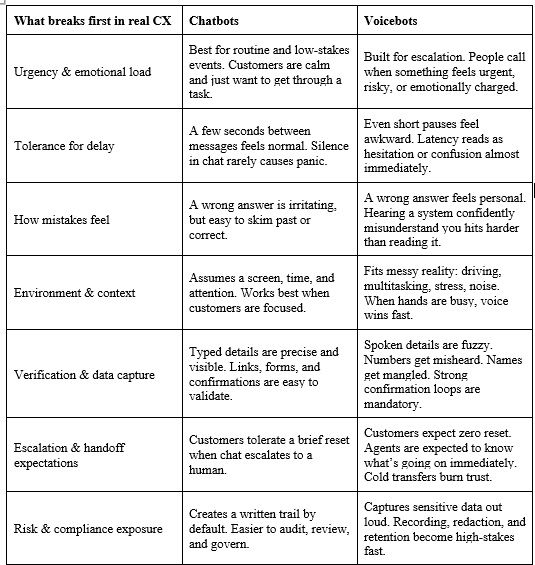
Chatbots vs voicebots: the Differences that Matter
Keeping it simple:
Chatbot vs Voicebots: How To Choose
Choosing between chatbots vs voicebots isn’t about preference or pricing. It’s about fit.
Step 1: Sort conversations before you sort tools
Start with the conversations, not the software.
Take your top support intents and score them across four dimensions:
- Urgency
- Ambiguity
- Emotional weight
- Risk
Keep it simple. A rough 0–3 scale is enough. High urgency and high ambiguity almost always push toward voice or a human. Low risk and high volume point toward chat. Anything in the middle needs guardrails.
Step 2: Find where journeys break and check for readiness
Look for the handoffs. Where chat turns into a call. Where a “resolved” ticket shows up again two days later. Where agents keep hearing, “I already talked to the bot.”
Those breakpoints tell you where chat runs out of patience and where voice becomes necessary.
It’s also worth being honest about readiness. If knowledge is scattered, ownership isn’t clear, or escalation teams aren’t in place, automation doesn’t fix the problem. It spreads it.
Sometimes, the right answer in the chatbots vs voicebots debate is “neither, yet.”
Step 3: Pick an entry model, not a winner
Most experienced teams end up following one of three familiar patterns:
- Chat-first: chat handles intake and routine work, voice takes escalations.
- Voice-first: common in utilities, healthcare, and finance, where urgency dominates.
- Hybrid: chat qualifies and gathers context, voice resolves or reassures.
The key isn’t the model. It’s whether identity, intent, and policy travel with the customer. Without that, hybrid just means repeating yourself twice.
Step 4: Know what to look for when you assess options
Tools matter, but only after the design does.
For chat:
- Answers grounded in approved knowledge
- Memory within a single journey
- Escalation rules that fire early, not late
- Analytics that show where chat should stop
For voice:
- Low latency and natural pacing
- Support for interruption and correction
- Speech recognition that survives noise and stress
- Telephony flexibility and compliance basics
At scale, the best teams also test aggressively. Simulations make a big difference. If a system only works in perfect conditions, it won’t work on Monday morning.
Step 5: Design for failure on purpose
Every bot will fail. The difference is whether it fails quietly or catastrophically.
Good designs include:
- Confidence thresholds
- Explicit “I don’t know” behaviour
- Clear escalation triggers
- Structured summaries passed to humans
You need that governance wherever you land on the chatbots vs voicebots debate.
Step 6: Measure the outcomes
Instead of celebrating deflection or containment alone, track:
- Confidence that the issue is actually solved
- Repeat contact rates
- Time-to-outcome, not time-to-response
- How often customers have to re-explain themselves
When you see evidence that the system is working, scale slowly. Don’t rush straight into multimodal.
Chatbots vs Voicebots: Making the Right Choice
Honestly, there’s not much of a choice to be made at this stage. Most companies are already designing bots capable of handling multiple channels. The key is figuring out where AI for chat and AI for voice should fit in the customer journey.
Most customers don’t care who’s answering them. They care whether the problem goes away. They care whether they feel listened to, and whether they’re about to explain the same thing again in five minutes.
Chat works when the path is clear. Voice works when it isn’t.
Where teams keep tripping up is trying to force one channel to do every job. A chatbot stretched into emotional territory. A voicebot pushed into conversations that should’ve been quick and quiet. Dashboards that look great while customers quietly bounce between channels, looking for someone who actually understands the issue.
The teams doing this well don’t talk much about voicebots vs chatbots. They talk about where things break. They notice when people switch from typing to calling. They design for those moments instead of pretending they shouldn’t happen.
Get the sequencing right, and chatbot vs voicebot stops feeling like a decision you have to justify. It just becomes how problems get handled, without much drama.