
June 23, 2026
Salesforce Wants to Run Your Entire Contact Centre From One Screen With New Workforce Engagement Management Offering
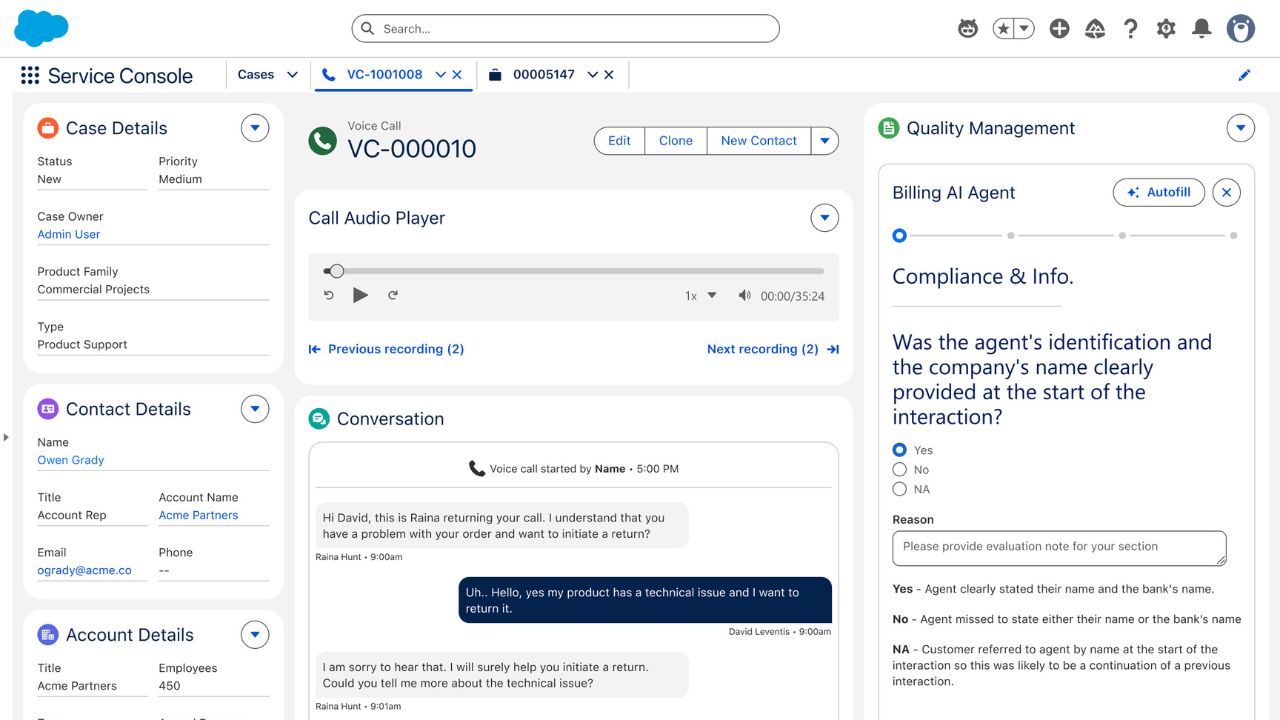
Contact centre workforce engagement management has a new competitor. Three months after launching Agentforce Contact Center at Enterprise Connect, Salesforce has returned to the stage, this time at Customer Contact Week in Las Vegas, to fill in what was feasibly the most conspicuous gap in its new CCaaS stack: workforce management.
The company announced the general availability of Agentforce Contact Center Workforce Engagement Management this week. It brings scheduling, quality management, and performance oversight of both human agents and AI into a single platform. Running an AI-powered contact centre without unified workforce tools is a bit like fitting a new engine and forgetting the dashboard. Salesforce, evidently, has decided it would rather not leave that gap to a rival.
The centrepiece of the launch is the Agentforce Service Command Center. This is ostensibly a renaming of the existing supervisor desktop that reflects what Salesforce is now asking it to do. Supervisors can see AI and human activity in one place, monitor performance of both live and AI agents, and update human agent presence, queue, and skill assignments in real time. They can execute this all within the same system where Agentforce agents are managed.
- Salesforce Buys Fin for $3.6 Billion, Adding a Fast-Deploy Customer AI Agent to Agentforce
- Salesforce and Databricks Partner to Elevate Cross-Platform Data Governance Guardrails for AI
What Has Actually Launched in the Workforce Engagement Management Solution
The WEM suite has three components. The first is native workforce management. This encompasses forecasting, scheduling, and intraday adjustment built directly into Salesforce rather than sourced from a third-party integration. The second is quality management. This allows supervisors to review interactions across channels, score them against defined standards, and link evaluations to outcomes, including customer satisfaction and resolution rates. The third is the Command Center itself, the unified supervisory view that connects the other two.
Slack serves as the mobile engagement layer. Agents can check in to schedules, request time off, and report absences through Slack without logging into the main CRM. This is a practical detail that will matter most to organisations already running Salesforce’s collaboration infrastructure.
The quality management element represents the sharpest operational change. Traditional contact centre QA has always relied on manual sampling, as in a supervisor listening to a small selection of calls. AI-driven quality scoring across up to 100% of customer interactions replaces manual sampling at 1–3% coverage. The difference is not incremental. It changes what quality management can realistically mean for a contact centre team.
For organisations not ready to move their telephony infrastructure, Salesforce confirms the platform integrates with more than 17 CCaaS partners. Existing contact centre infrastructure does not need to be replaced to access WEM capability.
Why the Market Is Ready for This
Workforce management has historically sat with specialist, standalone providers such as Verint or Aspect. Traditionally, it has existed entirely outside the CRM environment, requiring custom integrations to connect with the systems where customer interactions actually take place. For most contact centres, that has meant a perpetual data reconciliation problem. Performance lives in one system, scheduling in another, and customer context in a third.
The arrival of AI agents has made that fragmentation more problematic to ignore. When a single customer query moves between an AI agent and a human representative in the same session, separate systems tracking each half of the conversation create authentic governance and reporting gaps.
Salesforce’s argument is that the data already lives in the platform, so the workforce tools should too. The company is positioning Agentforce Contact Center WEM as the only WEM solution with AI, CRM, and every channel built in. The challenge is whether it can match the functional depth of established WEM specialists. These are vendors with decades of forecasting methodology behind them. That prospect is a fair challenge for tech buyers to put to both parties before signing anything.
Mike Cliffe, Product Lead of Workforce Engagement at Salesforce, wrote in an announcement blog:
“With native workforce management, quality management, and insights through Command Center, service organisations can make smarter staffing decisions, deliver more effective coaching, and gain visibility into both human and AI performance from a single platform. No disconnected systems to integrate, no information silos to manage.”
What This Means for Contact Centre Operations and Salesforce Customers
The Verint State of Agent Experience 2026 report finds that 31% of contact centre agents plan to leave their current role within six months. For a 1,000-agent centre, replacement costs alone reach roughly $6.2 million annually. Better scheduling and more targeted coaching will not solve a retention crisis on their own. However, they address some of the more tangible frustrations that push agents out the door.
For supervisors, the unified Command Center is the more immediate proposition. Reconciling AI and human performance data across separate systems carries a supervision overhead that worsens with scale. A single view saves time, but it also changes what a supervisor can realistically accomplish during a shift.
Salesforce’s own Mobile Worker Research Report finds that 87% of respondents believe AI agents could improve job satisfaction. Naturally, it’s worth flagging that this is vendor-commissioned research. But it’s directionally consistent with broader industry evidence that agents given more control over scheduling and development tend to stay longer.
The other key topics for tech buyers are perhaps more practical. These include implementation and migration costs, the implications for existing WFM vendor contracts, and whether the full WEM capability is accessible without adopting the complete Agentforce Contact Center stack. Those answers will determine whether this is a straightforward platform upgrade or a longer, more complex conversation.