
June 18, 2026
Copilot Cowork For Dynamics 365 is Now Generally Available: Microsoft Winds Up Its AI Clockwork for CX Teams
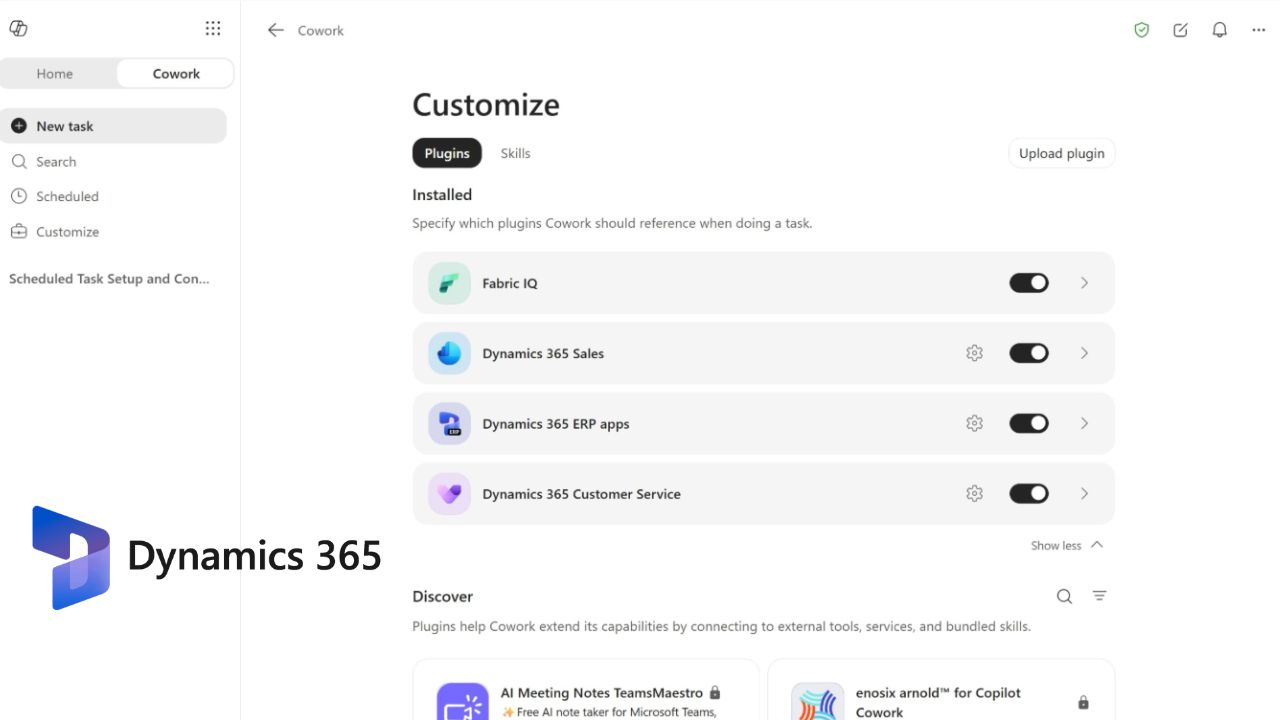
Microsoft has moved its Copilot Cowork platform into general availability worldwide, officially connecting its multi-step AI orchestration tool to Dynamics 365 Sales and Customer Service.
The release transitions the system from a three-month corporate preview into a standard production product. This arrives alongside a new commercial model that introduces usage-based pricing to the giant’s flagship enterprise tools.
The update introduces specialized plugins that allow the AI system to read and write directly to Dynamics 365 environments. On the sales side, this includes account preparation, pipeline risk assessment, and deal-progression forecasting. For customer service departments, the tool covers case triage, initial resolution drafting, and escalation hand-offs. Rather than functioning as a standard text box that generates standalone responses, Cowork handles multi-part background workflows. However, Microsoft emphasises that human oversight remains hardwired into the data loop.
Deva Rajamohan, Corporate Vice President of Dynamics 365 Customer Experience, wrote in an announcement blog:
“Cowork is where people delegate multi-step, multi-source work and review it, drawing across records, knowledge, email, and meetings, and increasingly across Sales and Customer Service together. It meets users where they already work in Microsoft 365, and it keeps a person in the loop the whole way: grounded in your records, governed by your permissions, and gated by human approval before anything is written back.”
The software operates through governed Model Context Protocol connections. This framework ensures the AI inherits existing enterprise identity and access controls. In practice, it can only retrieve data that the logged-in user is already authorised to see inside Dynamics 365. For example, an employee can instruct the system to prepare material for a quarterly business review. The tool will then gather relevant sales opportunities, open service tickets, and draft a summary document in a single pass, leaving the final approval to the user.
- CallMiner Embeds Deep CX Analytics into Microsoft Dynamics 365
- Microsoft Adds Conversation Orchestration to Dynamics 365, Elevating Live Queue Intelligence
What Does Copilot Work Tell us About the Pragmatic Multiverse of LLMs
The underlying engineering reveals an interesting commercial pragmatism from Microsoft. Despite its multi-billion-dollar investments in proprietary model architectures, Cowork runs by default on Anthropic’s Claude models, specifically Opus 4.8 and Sonnet 4.6. Arguably, this represents a calculation by Redmond to prioritise specialised task performance over vendor vanity in the enterprise market.
At the same time, the transition brings a distinct change in how software is financed. While standard Copilot features are bundled into flat, per-seat monthly subscription licenses, Cowork tasks are billed separately using consumption-based Copilot Credits. Microsoft claims its internal benchmarks show that running these tasks natively within Dynamics 365 is roughly 30% to 40% cheaper per prompt than routing them through external Claude connectors. However, the introduction of variable costs changes the math for procurement teams.
This variable structure is born of processing reality. Because agentic workflows run continuously in the cloud to execute multi-step scripts, they draw heavily on raw compute resources. Microsoft’s decision to implement granular cost controls, user-level caps, and opt-in switches by default suggests the company is acutely aware that uncontrolled autonomous prompting can quickly disrupt an enterprise IT and CX budget.
What Shifts on the Office and Contact Centre Floor for Dynamics 365 Users and Buyers
For the CX professionals actually using these tools daily, the development is less about structural market economics and much more about the tedious middle layers of admin work. In a typical contact centre, a significant portion of an agent’s shift is consumed by post-call documentation, data categorisation, and manual system updates. These are tasks that are necessary for reporting but do nothing to resolve user frustration. Cowork’s ability to pre-populate these records from a live interaction directly targets that specific operational friction.
Similarly, for account execs, the software aims to eliminate the manual data retrieval that usually precedes a client review. Instead of spending an evening cross-referencing activity logs to find where a deal has gone cold, a rep can have the system highlight missing stakeholder engagement or stalled timelines based on historical patterns.
The actual value of the system, however, hinges entirely on the quality of the environment it is entering. If an organisation has messy data or conflicting definitions of what makes a client “at risk,” the tool will simply format that ambiguity more quickly. The system provides a faster way to process existing information. However, the responsibility for accurate execution and clear process strategy remains firmly on the human side of the screen.