May 06, 2026
Ocado’s AI Service Bet Delivers Faster Support With the Human Touch
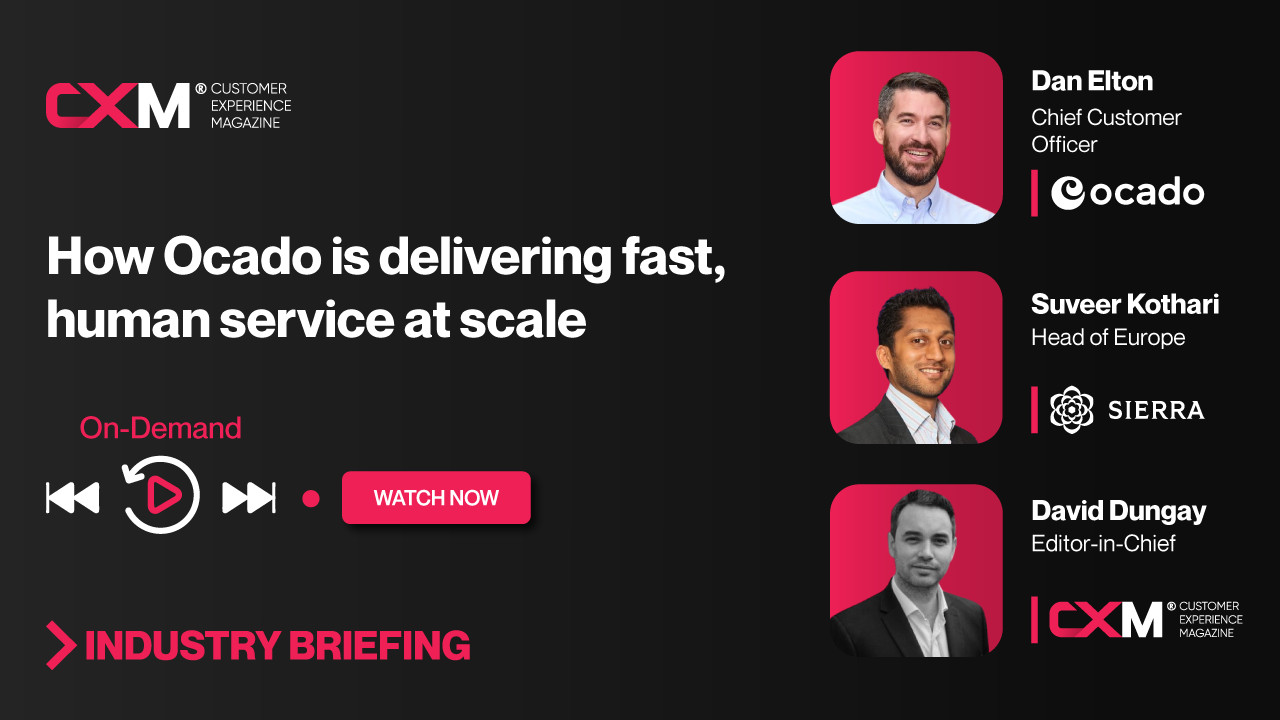
For years, customer service leaders have faced a familiar trade-off: improve service quality, or reduce cost. Doing both at once has proved far harder.
In a recent webinar, I welcomed Dan Elton, Chief Customer Officer, Ocado and Suveer Kothari, Head of Europe at Ocado’s technology partner Sierra AI to discuss how the popular UK grocer is approaching service quality in the age of AI.
In this conversation, we explored how Ocado is using conversational AI to deliver faster, more consistent service while keeping human advisors focused on the moments that matter most.
To listen to the full conversation, click here.
The discussion comes at a pivotal moment for the customer experience sector. Gartner predicts that by 2029, agentic AI will autonomously resolve 80% of common customer service issues without human intervention, contributing to a 30% reduction in operational costs. McKinsey has also estimated that applying generative AI to customer care could increase productivity by 30% to 45%.
For Ocado, the opportunity is not theoretical.
The online grocer currently handles around 30,000 customer contacts each week across phone, WhatsApp, chat and AI-assisted channels. Its 300-strong customer service team is fully insourced and based in Sunderland — a deliberate choice, Elton explained, because customer experience remains central to the brand.
The challenge was not simply to automate. It was to identify where automation could make the customer journey better.
High-volume, low-complexity queries became the natural starting point. “Where is my order?” is one of the most common examples. Customers can already track deliveries in the Ocado app, but some still prefer to ask through chat. By connecting Sierra’s AI agent to Ocado’s order systems, those customers can now get quick, conversational answers without waiting for a human advisor.
Refunds are another early use case. Many refund requests are straightforward, making them well suited to AI resolution. For Ocado, this means customers get faster outcomes, while human advisors are freed up for more complex, sensitive or commercially valuable conversations.
That balance between automation and humanity was a recurring theme throughout the webinar.
Kothari argued that the next phase of CX is not about fragmented bots sitting in different channels, but a single intelligent AI agent operating consistently across voice, chat, WhatsApp and future customer touchpoints. In many organisations, he said, these channels have historically been siloed, creating inconsistent customer experiences. AI agents offer a way to unify service around one tone, one knowledge base and one operating model.
For Ocado, preserving brand identity was one of the biggest concerns. The company’s customer promise — “food at heart and life in mind” — shaped the way the AI agent was built. Crucially, the work was led by Ocado’s customer experience experts in Sunderland, not handed off entirely to a technology function.
Elton said the team used its own tone-of-voice guidelines and service standards to train and test the agent, running large numbers of simulations before launch. That testing continues after deployment, with conversations reviewed and improvements made quickly when needed.
This is one of the less obvious advantages of AI in service environments. Updating a script or process across hundreds of human advisors can take time. Updating an AI agent can be far faster, provided governance is strong.
Governance, inevitably, was another major focus. Kothari described Sierra’s approach as having “AI on top of AI”: real-time monitoring designed to detect when conversations drift off track, trigger escalation to a human, and protect against issues such as abuse or prompt injection.
Elton added that Ocado has also created internal review processes, involving customer service, technology and legal teams. The objective is not to remove risk entirely — no service operation can do that — but to understand and manage it properly.
The early results are encouraging. Ocado has already seen containment rates double compared with its previous chatbot approach, while customer satisfaction has remained stable. More customers are also choosing to use the AI channel, which Elton sees as an indication that the experience is lower effort.
The operational impact is beginning to show as well. As more routine contacts are resolved by the agent, Ocado has been able to redirect human advisors toward outbound customer engagement — work that can create value rather than simply manage inbound demand.
For businesses considering a similar path, the advice from both speakers was practical. Start with use cases where volume is high and complexity is low. Be clear about the metrics that matter, such as resolution rate, CSAT, customer effort and cost to serve. Understand the organisation’s appetite for risk. And, perhaps most importantly, make sure the underlying systems and APIs are ready.
Elton said one lesson for Ocado was the importance of having API architecture in place so the business can move faster as new use cases emerge.
Kothari also warned against waiting too long. AI in customer experience is evolving rapidly, and the biggest challenge may not be the technology itself, but the organisational change required to adopt it well.
For CX leaders, Ocado’s experience offers a useful blueprint. The company is not using AI to make service feel less human. It is using AI to remove friction from routine interactions, strengthen consistency and give its human teams more space to do the work only people can do.
That may prove to be the real promise of AI in customer experience, rather than replacing the human touch altogether it can be used to deliver experiences where, and how, they matter most.
To watch the conversation, click here.