
June 12, 2026
Fresh ServiceNow and Salesforce Layoffs Coincide With Growing Focus on AI Productivity
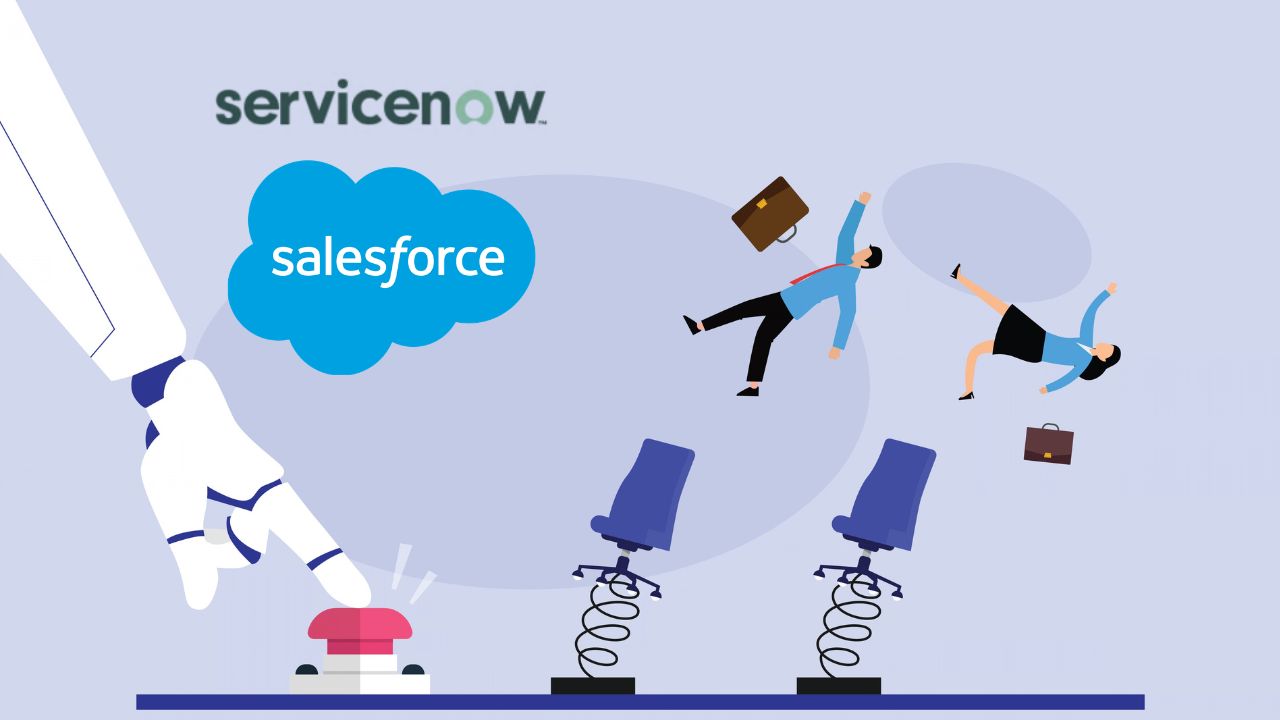
ServiceNow and Salesforce are both making workforce reductions, with executives at each company increasingly highlighting AI as a driver of productivity and organisational change.
The developments come as both vendors continue to invest heavily in AI-powered products designed to automate workflows, support employees and improve customer service operations. For the individuals affected, however, the story is naturally more personal. Workforce reductions bring uncertainty for workers and their families, regardless of the strategic rationale behind them.
For the wider market, they raise questions about how AI-driven productivity gains could reshape workforce planning in the years ahead.
ServiceNow has reportedly cut hundreds of roles across a range of functions, including sales, consulting and marketing. The company has not framed the changes as a response to weakening demand. Instead, execs have pointed to ongoing organisational reviews and the need to align resources with strategic priorities, particularly around AI.
The company has also suggested that productivity gains from AI could reduce the need to replace employees who leave through normal attrition.
The layoffs come against a backdrop of continued growth. ServiceNow recently reported subscription revenue growth of 22% year on year, suggesting the company is pursuing efficiency improvements while expanding its business.
For employees affected by the cuts, strong financial performance may offer little comfort. Yet the combination of growth and restructuring is precisely what makes these developments noteworthy. The discussion is no longer confined to cost-cutting during difficult markets. Increasingly, it is taking place alongside investment and expansion.
Salesforce’s AI Expansion Continues Alongside Job Cuts
Salesforce has followed a similar path. The CRM giant has undertaken several rounds of workforce reductions over the past year, including 1,000 in February. These included cuts affecting teams linked to some of its AI initiatives. At the same time, Salesforce continues to position Agentforce as a central pillar of its growth strategy, recently reporting more than $1 billion in annual recurring revenue for the platform.
This week, a notice was filed that a further 86 workers would be laid off from its Mission Street Office in San Francisco in August. The cuts are also occurring as Salesforce continues to invest aggressively elsewhere. Alongside its AI push, the company recently announced the acquisition of revenue management specialist M3ter. Last week, Salesforce announced it had acquired Contentful. Workforce reductions are taking place during a period of continued investment rather than retrenchment.
The CRM giant is also buying back a significant volume of its own stock as part of a $50 billion repurchase authorisation rubber-stamped earlier this year.
Speaking in September 2025 about the impact of AI within Salesforce’s support operations, CEO Marc Benioff offered one of the clearest public examples yet of a technology executive linking AI adoption to workforce planning:
“I was able to rebalance my head count on my support. I’ve reduced it from 9,000 heads to about 5,000 because I need less heads.”
Neither company has publicly disclosed a detailed breakdown of how specific AI deployments have translated into individual workforce decisions. However, both have increasingly pointed to AI-driven productivity gains as an important part of their operating model.
The Bigger Picture Around AI, Productivity and the Workforce
For both tech buyers and CX team leaders, the pattern is difficult to ignore.
For years, vendors have claimed that AI can automate routine work, increase productivity, and allow employees to focus on higher-value activities. Now, some of those same vendors appear to be applying similar principles internally.
The irony is that software companies may be becoming the first large-scale case studies for the technologies they are selling.
None of this should be interpreted as evidence that large-scale workforce reductions are an inevitable consequence of AI adoption. Technology deployments, organisational structures, and labour markets differ widely between companies. What the developments do illustrate is the growing pressure on business leaders to determine where automation can add value and where human expertise remains essential.
Even so, the fact that senior executives are openly discussing AI as a factor in workforce planning suggests the conversation is moving beyond pilots and proofs of concept.
For tech leaders, the strategic questions are considerable. For workers across the industry, however, the conversation can feel considerably more immediate. As AI becomes more capable and more widely adopted, organisations will increasingly be judged not only on the productivity gains they achieve, but also on how they manage the human consequences of change.