
May 22, 2026
Engage Employee Summit 2026: More Listening, Less Friction and Leaders Getting Vulnerable
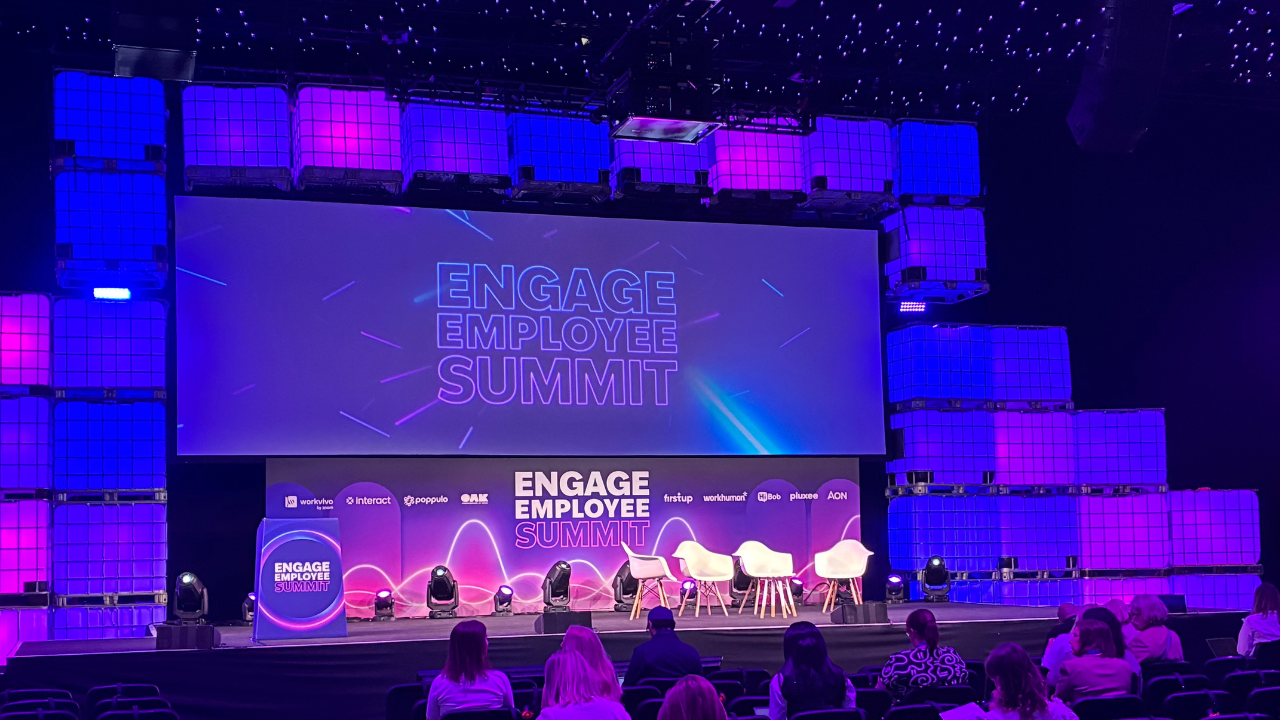
On 20-21 May, Engage Employee Summit 2026 brought together practitioners from across HR, employee experience, internal communications and people strategy. Across the two days, there was very little theory, and a lot of accountability. At a time when many events are dominated by future-gazing and AI-heavy agendas, this was a refreshing change.
AI was part of the conversation, but it wasn’t the centre of it. Instead, the human themes of trust, connection, leadership, and listening took precedence. And where AI did come up, it was through the lens of a practical question: how do we use it while keeping people at the heart of our workplaces?
Here are the themes that showed up across the two days.
Listening Without Closing the Loop is Just Data Collection
How do you connect with people who are 30,000 feet above you? Kate Marks, Head of People Insight and Listening at EasyJet, shared a compelling account of how the British airline set about improving employee voice across their 20,000-strong workforce – including the 80% who work on the planes.
A distinct EX challenge for airlines is that the office is essentially the aircraft. The seven people on board are your team, with the captain in charge, so the culture and experience shifts every day depending on who is on board. That context makes employee feedback both especially difficult and especially important.
The crew didn’t feel they were being listened to, and trust was eroding as a result. Marks outlined a three-year roadmap to rebuilding that trust through listening. Airwaves – the airline’s new shared listening system – launched first with base managers and captains, focused on how to unlock trust in their bases. The ambition is to democratise the platform over time, expanding access and moving towards real-time channel data.

Jane Garnsey, People COO at Skipton Building Society, described building trust through a reframe at leadership level. Their new CEO set the tone organically: “We in head office are here to serve you. Your voice needs to be louder because you’re serving our customers every day.” That shift in messaging helped rebuild trust with branch colleagues.
The theme resonated on the expo floor, too. Jaime Valle, Customer Experience Consultant at Teresa Monroe, told me: “It’s very tempting to do the survey and stop there. The fun stuff starts when you do something about it.”
Removing Friction in the Employee Experience
It’s easy, in internal communications, to assume that low engagement means you need a better message. Katie Klimaytys, Director of Global Internal Communications at Visa, made a compelling case that the diagnosis is usually wrong.
For Visa, the problem was low uptake on their volunteering programme. Rather than investing in more persuasive communications, Klimaytys redesigned the programme with real-life constraints in mind. And critically, the content itself was tied to things employees actually wanted: career development, connection with leaders, and genuine fun. Visa now runs skateboard-making sessions in its offices across the globe, with the finished boards going to foster children.
Participation went from 18% to 51% in two weeks, against a target of 31%. Every participant said they’d volunteer again. And, most remarkably, leaders are now using their own offsites as volunteering sessions without being mandated to.
“People will meet the moment if you meet them where they are,” Klimaytys said. “They don’t need convincing, they need fewer obstacles.”
The friction-removal theme showed up elsewhere too. Nicola Marshall, People Director at Welcome Break, described building a platform personalised down to brand and region – so a team member at a motorway Starbucks sees something entirely different to a KFC colleague two units along. “We have cultures within cultures,” Marshall noted. Welcome Break has 15 distinct brands under its roof, and the communications infrastructure has to reflect that – otherwise employees simply aren’t seeing what’s relevant to them.

The EX–CX Link is Increasingly a Commercial Argument
The connection between employee experience and customer experience is well established in theory. What stood out at Engage Employee Summit was the number of organisations making it operational.
The most striking example came from Erste Bank Poland. Lukas Pelikša, Chief Employee Experience Officer, described the bank’s Total Experience model – a strategic management choice that gives equal weight to employee and customer experience, and deliberately sits outside HR. Emotions are foundational to the approach. “Emotions are deeply operational. If we’re serious about experience, we must be serious about managing emotions,” Pelikša said. The results include an eNPS five times higher than the banking sector average, and a proven, direct correlation with NPS scores.
In a panel discussion on day two, Daniela Hoyos, Global Employer Branding and Employee Engagement Manager at Swissport, made a similar argument. “A commercial conversation and a people conversation are the same,” she said. “The people team are the ones that deliver on the promise for our customers.” For Swissport, which relies heavily on seasonal workers during high-volume periods, a consistent employee experience is critical as it determines whether they have the talent to meet customer demand.
The observation was echoed on the floor. Stephanie Gandon, Experience Advisor at Teresa Monroe, noted that the EX–CX link has historically been driven from the customer experience side looking in. What felt different at this event, she said, was the direction of travel: HR and people teams are now owning that connection, not waiting for CX to make the case for them.

AI is Moving Faster Than Leadership Confidence
A clear tension surfaced across the two days: organisations are under pressure to move fast on AI, but the human infrastructure – trust, capability, clarity – isn’t keeping pace.
Nick Lynn, Managing Director at WTW, framed it through Martec’s Law: technology changes exponentially, but organisations change incrementally. That gap, he argued, is where most leaders are currently operating (and struggling). The organisations handling it best, Lynn said, are narrowing their focus. They focus on four pillars: clarity, confidence, connection and capability, each reinforcing the other. The shift is from engagement as a metric to impact as an outcome.
The practical challenge of that gap showed up in a panel on AI-redesigned work, where Katy McIntyre, Chief People & Strategy Officer at Hammonds, made the point that: “Everyone is a beginner again. Knowledge is no longer power.” This is tough for leaders to contend with, but they need to get vulnerable and be ok with not having all the answers.
Abi Goodwin, Group Director for Strategic Workforce Planning and People Services at Sky, added that the answer is to be intentional with AI adoption. Sky has made a values-based decision not to use AI in certain contexts, even where technically it could. “Just because you can doesn’t mean you should,” Goodwin said. Trust, she argued, is hard to win and easy to lose.
On the floor, Miranda McLaughlan, Internal Communications and Events Manager at London Gatwick, captured the mood of the conversation well: “There is a general feeling that AI is a tool that can help people work more efficiently and reduce the sheer volume of content we deal with in internal comms – but keeping a human in the loop is the only way to really keep the employee experience authentic.”
Closing Thoughts
There was a common thread running across the sessions and conversations at Engage Employee Summit 2026. The evidence from the organisations on stage suggests that narrowing focus, putting impact front of mind, and embedding simplicity into design is what makes the difference. Activity is often mistaken for progress. But the organisations seeing results have paused, got clear on what actually matters to their people, and built from there.