
February 23, 2026
Same Experience, Different Score: How Cultural Bias Breaks Global CX Measurement

If your company runs customer satisfaction surveys across multiple countries, you might believe a high score means happy customers and a low score means trouble.
Yet, according to the latest research from Ipsos, When Difference Doesn’t Mean Different, that assumption could be leading your business to make seriously flawed decisions. The culprit is a phenomenon called cultural response bias.
What Is Cultural Response Bias?
Cultural response bias is the tendency for people in different countries to rate things differently on survey scales, regardless of whether their actual experience differs. Some nationalities consistently gravitate towards the top of a rating scale, while others habitually hold back. Neither group is wrong; they are simply products of their culture, their education system, and their social norms around expressing praise or criticism.
The problem is that most global CX programmes treat a nine out of ten from a customer in São Paulo the same way they treat a nine from a customer in Tokyo when they shouldn’t.
Ipsos has been studying this issue since 2018, and its third edition of the report, authored by Fiona Moss, confirms that the pattern hasn’t gone away. If anything, the expanded dataset makes the picture sharper.
The Numbers That Tell the Story
Look at two customers who are equally satisfied with their bank. One is in Puerto Rico, and the other is in Japan. Ask them to rate their experience out of ten, and you might get a score of 8 or 9 from Puerto Rico, and a 5 or 6 from Japan. Not because the Japanese customer had a worse experience, but because giving top marks is culturally uncommon in Japan.
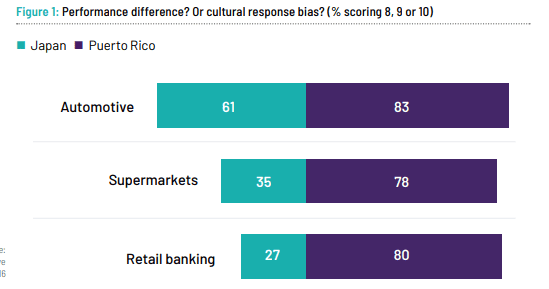
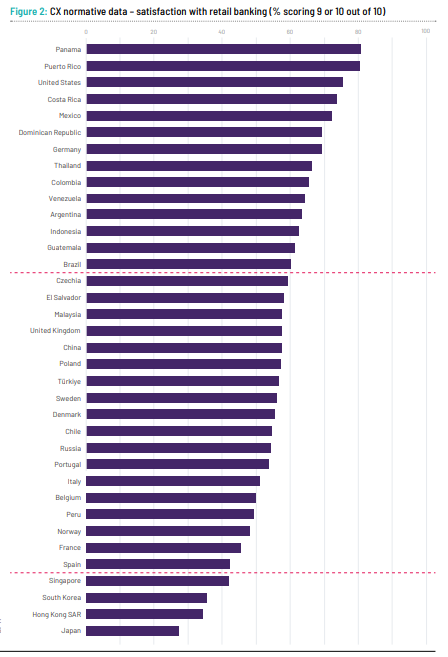
This isn’t an isolated quirk between two countries. Ipsos mapped the pattern across dozens of markets, and the results show a consistent hierarchy. Latin American markets, such as Panama, Puerto Rico, Mexico, and Costa Rica, appear at the top of the chart. Asian markets, like Japan, Hong Kong SAR, South Korea, and Singapore, cluster at the bottom. Meanwhile, European markets sit somewhere in between.
It’s Not Just a CX Problem
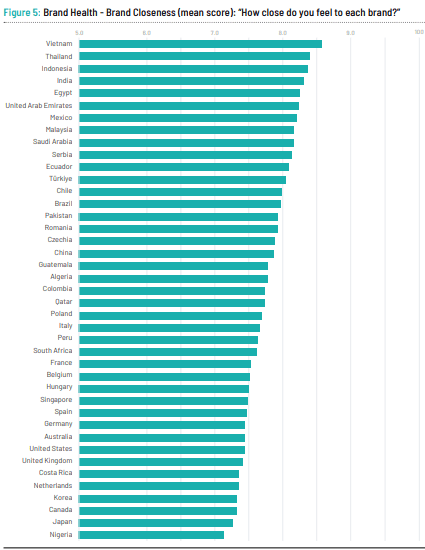
One of the most important new findings in this edition of the Ipsos report is how far cultural response bias extends beyond customer satisfaction surveys. When the researchers applied the same analysis to brand health data, the results looked almost identical. Vietnam, Thailand, Indonesia and India scored highest for brand closeness. Japan, Korea, and several Western European markets sat at the bottom, the same countries that consistently underperform on CX scores.
The same pattern appeared in employee satisfaction data, which showed workers’ rating pride in their employer scored along the same cultural lines. Cultural bias doesn’t switch off when the topic changes. It runs deeper than any single survey subject, making it a structural problem for any global programme that relies on consistent measurement as a strength.
The Hidden Risk for Global Businesses
If a leadership team looks at a dashboard showing satisfaction scores by country and sees France at 42% and Colombia at 78%, they may conclude that the French operation is failing and needs urgent intervention. They might reassign budget, put local teams under pressure, or overhaul a service model that is actually working well.
But if a French customer giving a seven out of ten is functionally equivalent to a Colombian customer giving a nine, there is no performance gap. There is only a measurement gap and no one told the decision-makers.
This is exactly the kind of mistake that happens in boardrooms when global data is presented without cultural context. It is also made worse by the fact that cultural effects are notoriously difficult to separate from genuine performance differences. A country that scores low may genuinely have worse service, or it may just have a culture that scores low on everything. Telling the difference requires more than a raw number.
Regional Generalisations Miss the Point
The 2025 Ipsos report warns against leaning on regional generalisations as the data is far too granular for sweeping labels like ‘Asian markets score low’ or ‘Latin American markets score high’ to hold up.
Some Asian markets appear among the high scorers. Some Latin American markets are more restrained than the regional trend suggests. Francophone African markets tend to score lower than Anglophone African markets, a distinction that only emerges when the data is broken down to the country level.
The research also notes that political and social context can disrupt the usual cultural response patterns. When surveys touch on societal issues rather than everyday experiences, strong feelings about political realities can override the ingrained tendency to score high or low. So the same market that reliably gives mid-range scores on product satisfaction might respond very differently when asked about institutional trust.
This is a reminder that effective CX measurement requires more than a consistent questionnaire. It requires ongoing sensitivity to the context in which the questionnaire is being answered.
If Japan’s score rises from 32% to 38% over two years, that is meaningful progress, even if it still sits below France’s 47%. Within-market improvement is a more honest signal than cross-market ranking.