June 08, 2026
Salesforce Secures Big Win With New FIFA World Cup 2026 Agentforce Deal
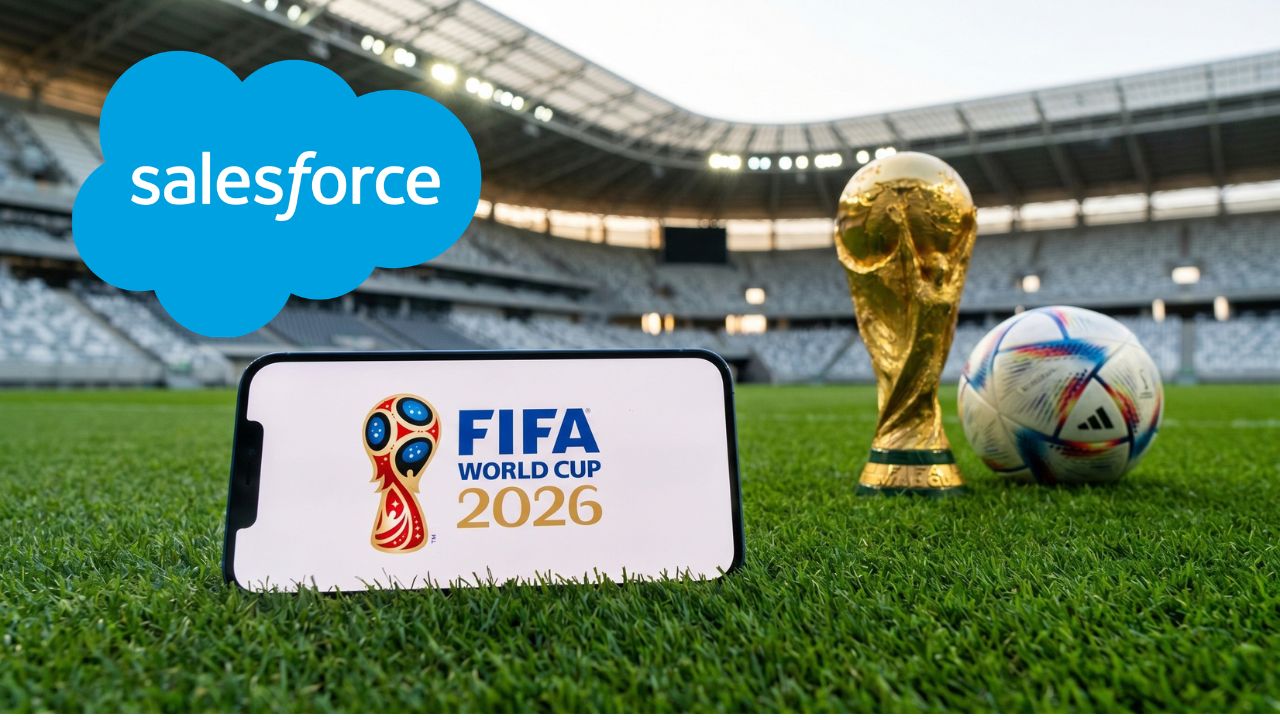
FIFA has named Salesforce as an Official Tournament Supporter of the 2026 Men’s World Cup. Its Agentforce 360 platform and Slack will handle workforce coordination, tournament operations, and stakeholder engagement across both competitions. It will also be an official partner for the 2027 Women’s World Cup.
The men’s tournament is the largest in World Cup history, featuring 48 teams playing 104 matches across 16 host cities in Canada, Mexico, and the United States. It kicks off on 11 June 2026. Salesforce technology will be active across all 16 cities, supporting everything from volunteer management to fan engagement. The partnership extends to the FIFA Women’s World Cup 2027 in Brazil. This will be the first edition of that tournament to be held in South America.
FIFA’s Chief Business Officer, Romy Gai, said the partnership reflected the scale of what both tournaments demand:
“The greatest tournaments require the very best partners alongside us. Salesforce’s technology and expertise will help support the delivery of two landmark competitions, connecting participating teams, Host Cities, volunteers, partners and fans through innovative digital solutions.”
Salesforce’s involvement extends beyond branding. The Agentforce 360 platform will manage communications and coordination across a stakeholder ecosystem that spans host city authorities, commercial partners, volunteer teams, and broadcast operations. These will all run simultaneously across three countries and multiple time zones.
- Salesforce’s AI Agents Now Handle Double the Volume of Its Human Ones
- Salesforce Confirms Contentful Acquisition in Bid to Own End-to-End Customer Experience
Market Analysis of the Salesforce and FIFA Deal
The partnership is a conspicuous play by Salesforce to present its agentic AI credentials in front of the largest possible audience. The company has been positioning Agentforce as its answer to enterprise demand for AI that doesn’t just surface information but acts on it. This encompasses routing tasks, coordinating teams, and managing workflows without constant human prompting.
Deploying that capability at the World Cup is, in effect, a very public reference site. The operational complexity is visible and authentic. There are 16 cities, each with distinct logistics, local authority relationships, and staffing structures. Additionally, all will need to stay coordinated in real time. If the platform handles it cleanly, Salesforce will have a case study that no analyst report can replicate.
“We look forward to helping create more connected experiences for fans, Host Cities, and other stakeholders while showcasing the potential of artificial intelligence and digital innovation on a truly global stage,” added Patrick Stokes, President and Chief Marketing Officer at Salesforce.
The Women’s World Cup element is also worth engaging with. Brazil 2027 represents a different kind of challenge. It is a single-country host with distinct audience demographics and a broader FIFA objective around growing women’s football globally. How Salesforce calibrates its fan engagement tools will be a different test from the logistical complexity of 2026.
What Agentforce at the 2026 World Cup Means for CX Teams
This is one of the more credible live deployments of agentic AI that the industry will get to observe this year. The use case, especially coordinating distributed teams, managing high volumes of stakeholder communication, and maintaining service quality under time pressure, maps directly onto challenges that contact centre leaders, operations managers and CX directors deal with routinely.
Naturally, it won’t answer every question a buying committee has about Agentforce. But once post-tournament case study material emerges, it should provide something more grounded than a vendor pitch deck. It should illustrate tangible evidence of how the platform performs when the operational pressure is real and the margin for error is tiny.