
June 23, 2026
Zoom Elevates Its Virtual Agent Contact Centre AI Platform With a Proper Feedback Loop
Zoom has updated Zoom Virtual Agent with tools for generating, testing, and optimising AI-powered customer service agents. This adds measurement and performance capabilities to its AI contact centre platform that, until now, was arguably stronger on deployment than on what comes after it.
The announcements arrive as part of CCW Las Vegas this week. They also include an expansion of ZoomMate with embedded AI agents for internal workflow automation, and a new on-premises AI option for regulated industries. None of this necessarily reinvents the contact centre, but the emphasis on performance measurement rather than deployment speed marks a considered shift in how Zoom is positioning the platform.
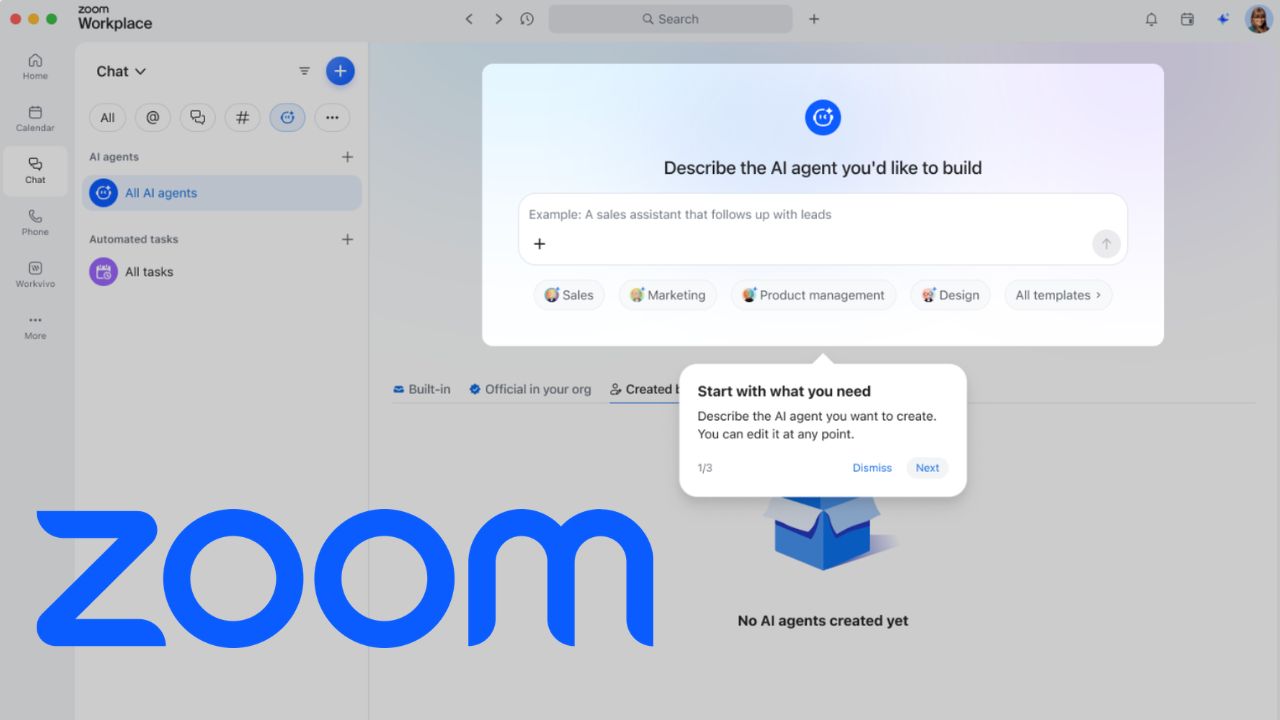
ZoomMate, available at $20 per user per month, now includes AI agents that help teams find information, automate follow-up, execute workflows, and coordinate action across connected business systems, including Salesforce, ServiceNow, Google Drive, Confluence, and OneDrive. Agents are created via a short prompt and accessed directly within Zoom Chat. This occurs either in one-on-one conversations or is added to existing channels.
“Organisations don’t need another tool — they need a system of action to solve today’s fragmented workflow,” commented Russell Dicker, Chief Product Officer at Zoom.
“The AI agents help teams take action directly within the flow of work, connecting information, workflows, and next steps across the organisation. As AI becomes a more active participant in everyday work, we’re focused on helping organisations move from conversation to completion faster and with less manual effort.”
What About Zoom Virtual Agent and Its AI Contact Centre?
The more substantive news for contact centre operators is what Zoom has done with Zoom Virtual Agent. Agent Architect is a Gen AI tool that produces production-ready voice and digital customer service agents from a simple prompt. It reads the intent behind a request, pulls in relevant data sources, and assembles workflows that handle complex customer interactions without requiring teams to build them from scratch.
Alongside it comes the Agent Performance Suite. It combines pre-deployment simulation, allowing teams to test agent behaviour against realistic customer scenarios before going live, with real-time dashboards covering resolution rates and containment. It also includes a quality management framework that evaluates AI, human, and hybrid interactions under the same standards. A third component, KB Suggestions, monitors successful human-assisted resolutions and drafts knowledge base articles from them for team review.
Chris Morrissey, General Manager of Zoom CX, said:
“It’s no longer just about deploying it to drive efficiency, but about having the context to drive personalisation at scale. But the challenge is eliminating the tradeoff between speed and sophistication, and Zoom CX bridges that gap so teams can personalise better, deliver faster, and drive stronger outcomes.”
Zoom Virtual Agent now also offers outcome-based pricing. This ties costs to resolved or successfully routed interactions rather than to seat count. For regulated industries, Zoom AI On-Prem processes AI workloads, including captions and transcription, within the organisation’s own infrastructure. It has English, French, German, and Swedish support at launch. Further languages, translation, meeting summaries, and agentic search are expected to follow later this year.
- Zoom Elevates Revenue Accelerator’s Conversational Intelligence With New OpenAI Plugin, MCP Connector
- Zoom Brings UK Data Hosting to Its Contact Centre and AI Tools — and Isn’t Charging Extra for It
What This Tells Us About Where the Market Is Heading
The contact centre AI market has spent three years in a state of enthusiastic deployment and uncomfortable silence when asked what those deployments have actually delivered.
Resolution rates and containment figures have improved reliably in vendor case studies and proved harder to reproduce at scale. The gap between AI in a demonstration and AI handling a difficult Monday morning queue has been the industry’s open secret.
Zoom is not the only vendor to have noticed. Salesforce, Genesys, and NICE have all moved to build evaluation and optimisation tooling around their agent platforms rather than leading purely with capability announcements. What makes Zoom’s position worth watching is the breadth of the bet. ZoomMate targets the internal workflow problem, and Virtual Agent targets the customer-facing one. Meanwhile, On-Prem targets the compliance-constrained enterprises that have been largely frozen out of the agentic AI conversation.
What It Means in Practice
For contact centre leaders, arguably, the Agent Performance Suite deserves more attention than Agent Architect. KB Suggestions in particular addresses something real. The standard failure mode in virtual agent deployments is a knowledge base that stops reflecting what customers actually ask within six months. This is usually because no structured process exists to keep it current. A mechanism that watches human agents resolve issues and converts those resolutions into candidate articles, without requiring a dedicated team to run it, closes a gap that most organisations paper over with quarterly review cycles that rarely happen on schedule.
Outcome-based pricing is worth a careful look from procurement teams. Moving from per-seat to per-resolution billing aligns Zoom’s commercial interest directly with operational outcomes rather than with licence renewal. This changes the nature of the vendor relationship in ways that CFOs evaluating long-term contracts should model explicitly.
For IT and compliance leads in financial services, healthcare, and the public sector, On-Prem is the most immediately relevant announcement. The launch scope is narrow by design, as it includes captions and transcription rather than the full agent capability set. However, the infrastructure commitment it signals is the point. Regulated enterprises evaluating AI vendors are not looking for everything on day one. Instead, they want a credible deployment architecture they can audit, govern, and extend at their own pace.
ZoomMate’s AI agents, meanwhile, are most useful for the internal operations teams supporting customer-facing work. These are the people managing CRM hygiene, post-call logging, and follow-up coordination across systems that do not naturally communicate with each other.