July 23, 2026
OpenAI’s Landmark New AI Agent Platform, Presence, Bets On Guardrails and Compliance, Not Bravado
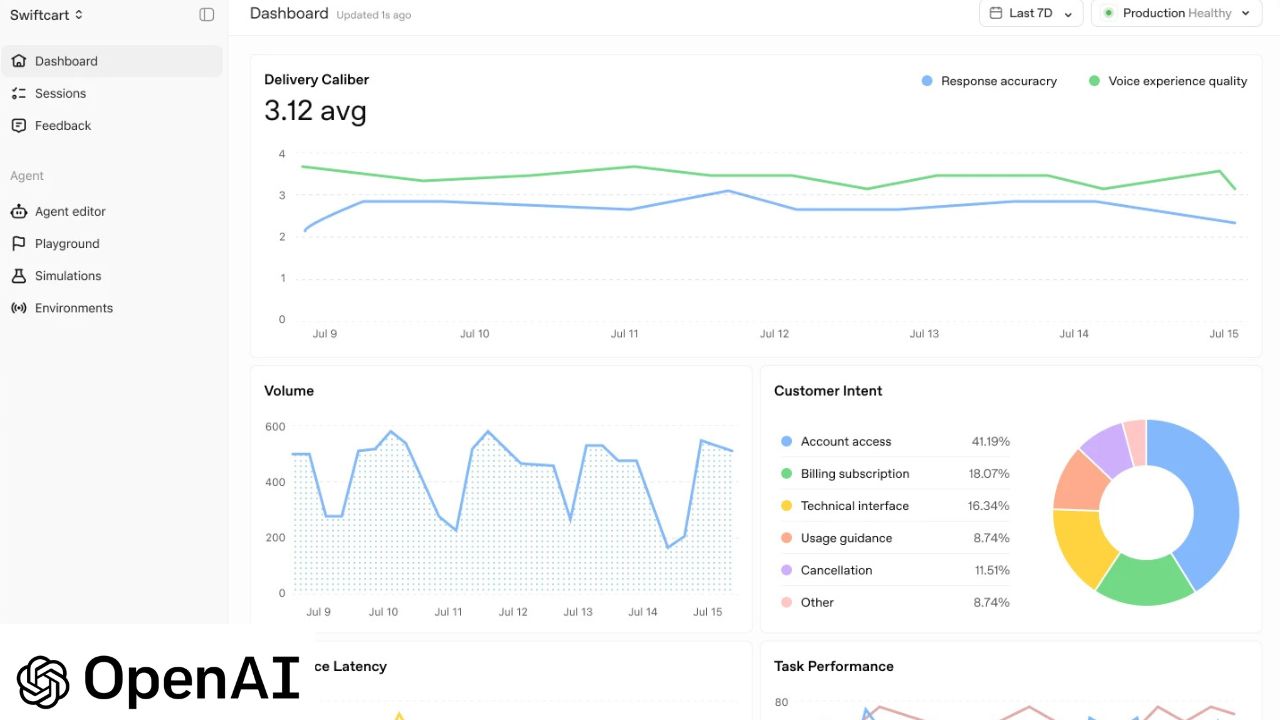
OpenAI has released Presence, a managed platform for running voice and chat AI agents inside customer and employee workflows. These include billing queries, insurance claims, and IT service requests. In OpenAI’s own framing, it’s built for organisations that need governed agents for high-volume, high-stakes work, not just a demo that behaves itself once. Rather than a new model, the company is selling the scaffolding around one. It encompasses policy controls, permissions, escalation rules, and a process for updating an agent once it’s live.
Each deployment is built around a single job. The agent gets access only to the systems and knowledge that the job needs. The client company decides what it’s allowed to do unsupervised, when it needs sign-off, and when a human takes over instead. Before anything goes live, OpenAI runs it through simulated conversations and edge cases to check it follows policy and escalates when it should.
Its announcement blog reads:
“Presence brings together the components teams need to run agents in production: policies and standard operating procedures, guardrails, approved actions, simulations, evaluation tools, and a Codex-powered improvement process.”
More Details on the Presence Platform
OpenAI is using its own support line as the reference case. The business says that Presence already handles the company’s English-language phone support at 1-888-GPT-0090. It adds that it now resolves 75% of inbound calls without a human stepping in. Human handoffs have been cut by 15 percentage points in the first ten days. When something goes wrong after launch, or a policy changes, Codex, OpenAI’s coding agent, reviews the production sessions and proposes fixes. Staff then test and approve before they ship.
Three named early adopters give a sense of where this is heading. BBVA is trialling AI voice support for everyday banking in Mexico. SoftBank is testing it for natural Japanese-language conversations. The Australian insurer IAG is looking at using it to support customers during disruption, such as severe weather.
Daniel Ordaz, Head of AI Transformation at BBVA Mexico, said:
“We are working closely with OpenAI to help shape and refine voice experiences for financial customer service.”
Presence is currently rolling out through a limited programme. OpenAI’s own Forward Deployed Engineers and a handful of systems integrators are running the actual deployments.
Reading the Market With This AI Agent Platform
None of the individual pieces here are new. Guardrails, simulation testing, and human escalation are all factors every serious AI vendor already talks about. From a market analysis perspective, the key might be how OpenAI is centring them as the product, rather than as a fine print around a model’s broader capabilities.
It puts OpenAI on ground it’s been edging toward since May, when it launched its consulting arm, the OpenAI Deployment Company. Model access is getting commoditised fast, and Presence looks like an attempt to sell the layer above it. Salesforce has been making a similar bet, recently rolling pay-per-resolution pricing into its Agentforce Help Agent so it only charges when an issue actually gets resolved. Zoom, too, has spent the past few weeks refining the tools to measure whether the ones it’s already shipped are working. The mood at NiCE World London earlier this month told a similar story. The industry conversation has transitioned to whether agentic AI survives contact with a live production environment without breaking something else.
What it Means Once an Agent is Answering the Phone
For CX teams, the most intriguing detail is the update loop, not the launch itself. Agent deployments rarely fail on day one. They fail gradually, as policies are tweaked and the agent falls out of step with the business around it. A formal process for proposing, testing and approving changes, instead of letting an agent drift or ripping it out and starting again, is a pragmatic and proactive solution to that (likely) problem.