March 06, 2026
How Generative UI Could Meet Rising Employee Expectations
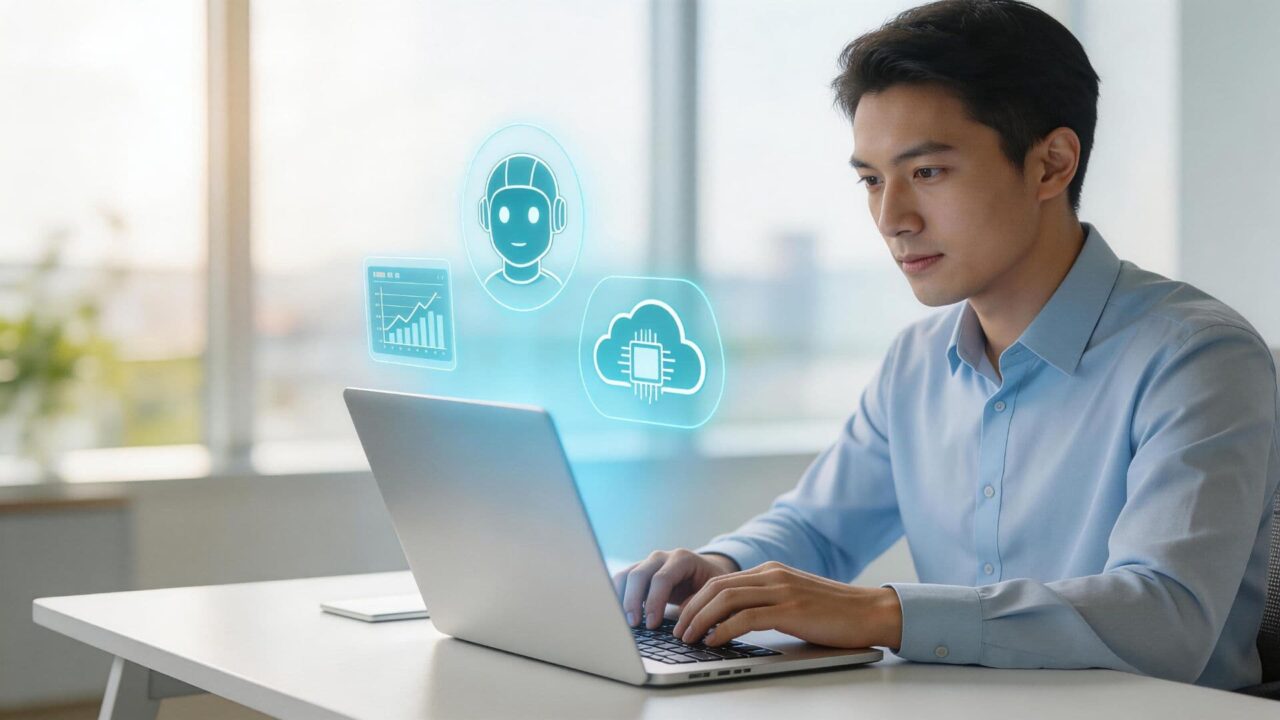
Consumer AI has raised the bar. Employees who use tools like ChatGPT or Gemini at home now sit down at their work computers and feel the gap immediately. According to a recent article by Jonathan von Rüden, Chief AI Officer at SAP, that gap is not just an irritation, current interfaces are holding back the pace of technological advancement. He believes that a new approach called generative UI (User Interface) may hold the answer.
The Problem with Business Software Today
Text is one solution. It lets employees express what they need naturally, with no onboarding required. It struggles to convey the kind of structured data that is common in business, however, and without real-time updates, text-based results can lose relevance the moment they are generated.
Graphical interfaces handle structured data better. They allow users to filter, sort and visualise information, and guide people through complex workflows. But they are expensive to build and slow to change, forcing generic, one-size-fits-all solutions that struggle to provide the fluid, tailored experiences employees now expect.
In essence, text is flexible but limited and graphical interfaces are robust but rigid. As the self-styled ‘generatuve UI company’, Thesys, explained in a blog post last year, the result is workers routinely ending up “stuck with irrelevant fields or navigating multiple screens” instead of seeing what they need, when they need it. Generative UI sits between these two extremes and, according to SAP, represents the “new frontier” for business software.
How Generative UI Can Help
Google Research defines generative UI as an approach in which AI creates “not only content but an entire user experience”, which can adapt dynamically to any prompt rather than presenting a fixed, predefined screen. CopilotKit, an AI copilot integration infrastructure provider, describes the shift being from hardcoding every element to an interface built in real-time around what the user needs in the moment.
Google has already put this into practice in its Gemini app, where a feature called “dynamic view” generates a fully customised interactive response for each individual prompt. In its own testing, human raters strongly preferred generative UI outputs over standard AI text responses.
SAP is applying the same principle to enterprise operations. Von Rüden offers a workplace example of a procurement manager needing to investigate a potential supply chain problem. Instead of spending her morning piecing together information from five different systems, she simply asks a question. A purpose-built workspace then appears with the right data, controls, and everything she needs to make a decision and act. Colleagues can join the same workspace without a briefing call.
The Impact on Employee Experience
There is an implicit subtext about the tools made available to workers. Technology clearly designed around the person using it communicates something about how an organisation values its people. Clunky, unresponsive tools send the opposite message, particularly to younger workers who arrive expecting their workplace technology to be as responsive as everything else in their lives. With appreciation shown to be the key behind workforce retention, this could have real consequences for a business.
This raises another point. Businesses don’t need to be afraid of making these changes as these expectations also reflect the amount people are already adapting to more dynamic applications. Regardless, organisations should be embracing employee reskilling, according to the latest WEF report.
Beyond expectations, generative UI is capable of reducing the time employees spend on mental busywork; hunting for information, switching between tools, piecing together a picture from disconnected systems. This friction is otherwise a quiet but constant drain on energy and focus. Removing it does not just speed things up. It makes work feel less exhausting and more within the employee’s control.
Another major practical and cost advantage of generative UI, as Thesys points out, is that when employees need tools for new tasks, those interfaces can be generated on demand rather than having to wait months for a development team to build them.
A ‘New Frontier’
The technology is still in its early stages, and both SAP and Google are transparent about that. The demand for more intuitive experiences at work is already present, however, particularly if people can be kept at the centre of the technology to enable better work, rather than replacing it altogether as we’ve seen at companies like Salesforce and Amazon. The latter can become a rather slippery slope as we are already seeing with white-collar workers facing redundancy in the not too distant future, but that doesn’t necessarily negate the space in which AI can genuinely improve work experiences.