


December 16, 2025
How One Phone Call Changed Lives – Human-Centred CX at Age UK
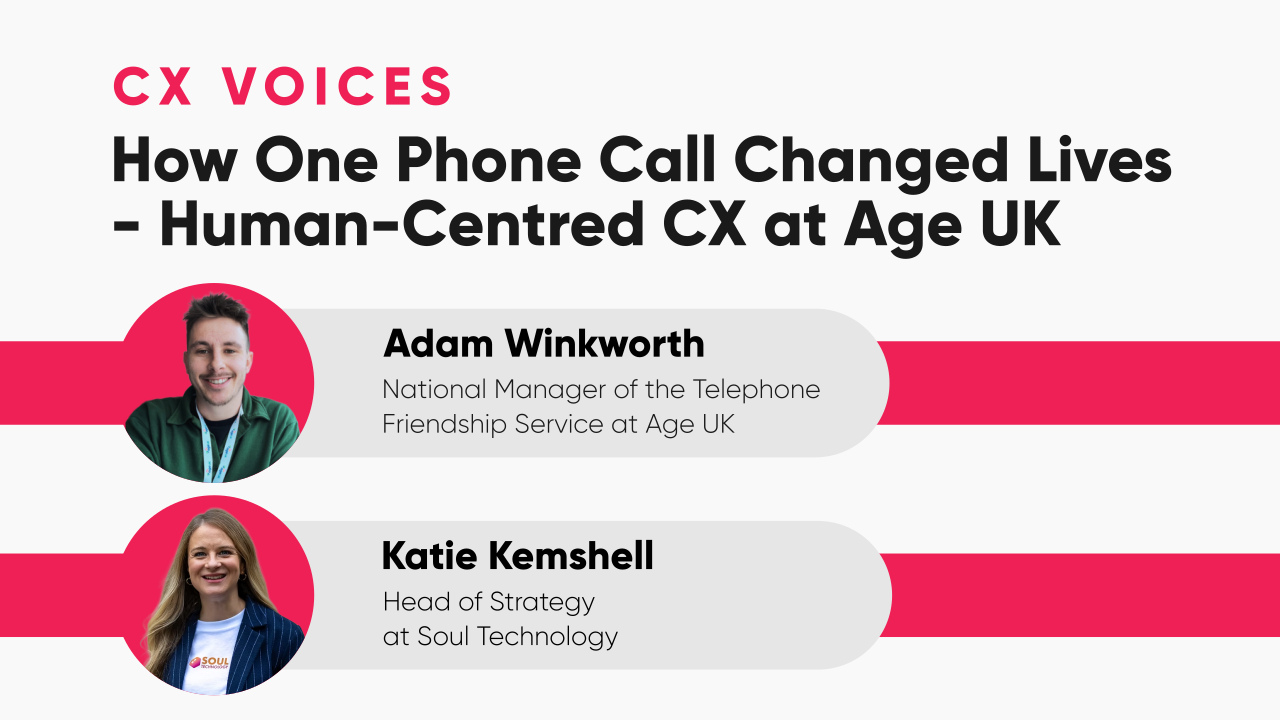
Customer experience is often defined in terms of efficiency, journeys, and transactions. However, in some cases, it serves as a vital support system rather than a sales tool. But what happens when CX isn’t about selling a product — and instead becomes a lifeline?
In the first episode of CX Voices Katie Kemshell, Head of Strategy at Soul Technology, examines this topic. Katie is joined Adam Winkworth, National Manager of the Telephone Friendship Service at Age UK.
At Age UK, customer experience prioritises connection, trust, and human dignity. In many cases, its not about speed or convenience. It’s about connection, trust, and human dignity — and, in some cases, the difference between isolation and belonging.
Watch the full conversation below
Customer Experience as Human Connection
Age UK supports older adults who may live alone, experience social isolation, or lack regular contact. For Age UK, the people they support are older adults who may be living alone, socially isolated, or without regular access to family or community. In this context, customer experience extends beyond traditional definitions.
As Adam explains in the episode, older people using Age UK’s Telephone Friendship Service seek genuine friendship, not a quick transaction. They’re looking for friendship.
The service provides weekly friendship calls between volunteers and older people across the UK, fostering — creating genuine, long-term relationships built on trust. In the last year alone, the service delivered over 5.3 million minutes of conversation.
This at scale brings both significant impact and enormous impact — but also significant responsibility.
The Responsibility Behind the Experience
Running a service of this size, 365 days a year, means safeguarding critical. Age UK must ensure conversations are safe, appropriate, and supportive — for both older people and the thousands of volunteers who give their time.
Previously, staff manually reviewed lengthy calls, often lasting hours, to identify potential risks. This approach presented challenges. Historically, this meant staff manually listening to long calls, often hours at a time, to identify potential risks. The challenge?
Most calls were safe, but brief. This meant while calls were shorter, higher-risk moments could easily be overlooked.
Using AI to Protect Trust — Not Replace Humans
Age UK introduced an AI-powered sentiment and risk identification tool, built using Microsoft Azure’s transcription services.
The goal was protection, not surveillance.
The system behaves in the following way:
- Transcribes selected calls
- Flags specific risk-related words (e.g., money, bank, scam, hungry)
- Assigns a risk score
- Allows staff to review only the relevant moments in context
This approach dramatically reduced the time spent on reviewing low-risk calls and improved the identification of, while increasing the likelihood of identifying genuine safeguarding concerns.
Crucially, AI does not make decisions — humans do. The technology filters out irrelevant information, allowing staff to focus on what matters.
Real Impact, Real Outcomes
The impact has been both tangible and measurable.
- Waiting times to join the service dropped from 27 weeks to zero days.
- Thousands of staff hours were saved.
- Safeguarding interventions became faster and more precise.
In one powerful example shared in the episode, a single mention of a bank during a call led to the discovery of an older person being targeted by a scammer. This brief moment, — which could easily have been missed, — resulted in support from safeguarding teams, police, and financial recovery.
Without the AI tool, this story may have gone unheard.
Trust Comes from Inclusion, Not Technology
Perhaps the most important lesson from Age UK’s journey is not about AI itself, but how it was introduced.
Older people and volunteers were involved throughout the process:
- Clear explanations of why the technology was being used
- Transparency about how data would be handled
- Space for concerns, questions, and feedback
Some people were understandably hesitant at first. Their concerns were acknowledged and not dismissed.
Maximising the Magic Humans Provide
Looking ahead, Age UK’s vision is clear. The end experience, i.e., a warm, meaningful conversation between two people should remain unchanged.
What should change are the barriers that get in the way of that connection.
As Adam puts it in the episode, “The role of AI is to maximise the magic that only humans can provide.”
By reducing administrative burden, identifying risks earlier, and supporting both volunteers and service users, technology serves as an enabler, not a replacement, for human connection.