December 09, 2025
Inside DVLA’s Quiet AI Revolution
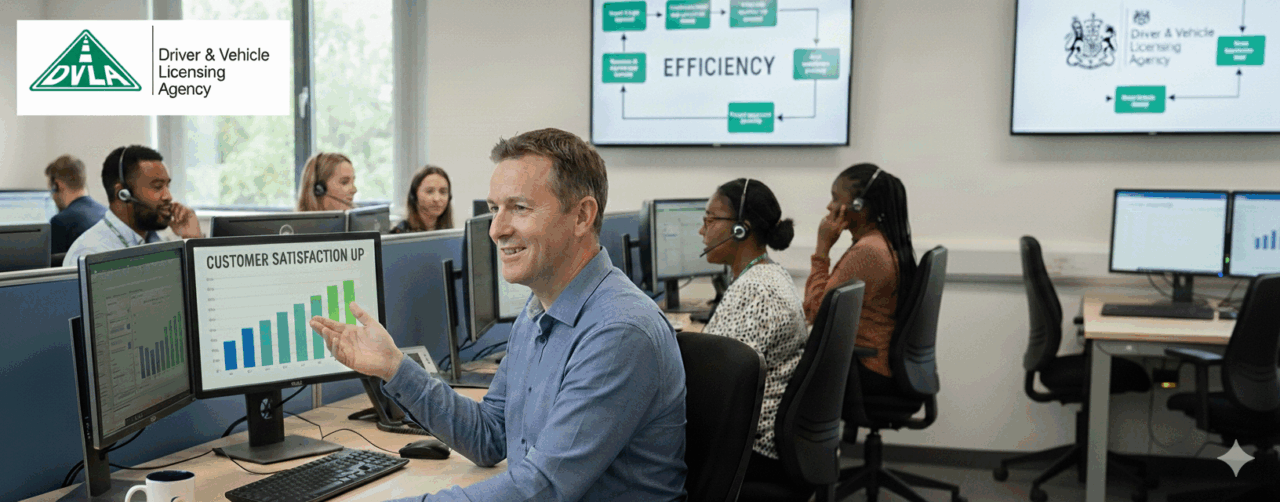
When the Driver and Vehicle Licensing Agency decided to overhaul its customer-service operation, it did so without fanfare. There was no flashy launch, no breathless tech campaign, no sweeping promises about “reinventing the public sector.”
Instead, DVLA embarked on a multi-year rebuild of a system that millions of UK citizens rely on daily — a transformation that hinged not on Silicon Valley swagger, but on something far more mundane, fixing the plumbing.
Rob Holohan, Head of Channel Management at DVLA, sat down with CXM to discuss the transformation and how Content Guru empowered the business to do more for customers.
Today, that work is beginning to bear fruit. Efficiency is up. Customer satisfaction has climbed. Staff morale has improved. And AI is carefully deployed, tightly supervised and is starting to reshape how the agency handles the UK’s vehicle-licensing workload.
But the story is more nuanced than a typical government IT success narrative. It’s a case study in how slow, deliberate, unglamorous technological change can quietly shift an entire organisation.
A System Held Together With Goodwill and Glue
Before the overhaul, DVLA’s contact centre was running on a patchwork of ageing systems.
Voice services on one platform. Digital channels on another. A knowledge base over here, reporting tools over there. Advisors juggle multiple screens to stitch together a customer’s story.
Holohan commented, “We had channels scattered across different platforms. No single pane of glass.”
For a public agency dealing with everything from driving licences to vehicle taxation, the fragmentation wasn’t just inconvenient; it was becoming untenable.
Industry analysts have long warned that legacy fragmentation is the number one reason AI fails in customer service environments. The data simply isn’t connected enough for machines or humans to make sense of it.
DVLA officials recognised the danger. If they wanted to modernise, they needed to bring everything into one coherent ecosystem. That meant committing to something most organisations avoid because it’s messy and painful – platform consolidation.
The first attempt at this transformation was underpinned by a very well-known CRM vendor. However, it soon became clear that this wasn’t the right fit for the DVLA’s transformational needs. This realisation led them to Content Guru, a much smaller organisation but with a pedigree of contact centre transformation projects.
Slow, Careful, and Sometimes Boring — By Design
The process unfolded in two phases.
Phase 1: Consolidate Everything
Every channel — voice, webchat, email, and social media — was migrated to a single cloud environment provided by Content Guru. Along the way, DVLA modernised the core toolkit:
- Speech and text analytics
- A new knowledge base
- Updated reporting suites
- A redesigned chatbot framework
It wasn’t glamorous. It wasn’t quick. It was exactly what the agency needed.
Holohan said, “Once everything was in one place, that’s when the exciting part could start.”
Phase 2: Build on Top of the New Foundation
Only after the infrastructure was unified did DVLA begin introducing AI.
First came telephony modernisation. That included natural-language IVRs and transactional routing, followed by three internal-facing AI systems:
- Real-time transcription and summarisation
- Agent Assist powered by an LLM
- Automated Quality Monitoring, analysing advisor calls at scale.
Then came WhatsApp support. Adoption surged almost immediately.
In a sector known for cautious IT projects and a risk-averse culture, DVLA’s approach was unusually methodical.
Big Numbers — and Subtle Shifts
The transformation’s impact is striking.
- 20,000 automated call transfers per month
- 30,000 call deflections using SMS and IVR messaging
- 300,000 chatbot interactions monthly
- with 20% fully automated resolution
For a high-volume public-sector body, those numbers are transformative. Customer experience improved too, satisfaction up 10% in two years.
Even more surprising: internal morale rose sharply.
- Civil Service engagement scores up 10%
- “I have the tools to do my job” up 16%
- Monthly attrition halved
“Efficiency was a driver, but the big wins were customer satisfaction and advisor engagement”, says Holohan.
The Most Unexpected Twist
Across much of the industry, employees are wary of automation. Contact-centre workers, in particular, fear that AI could replace them or hollow out their roles.
DVLA didn’t see that.
Holohan commented, “Honestly? We haven’t had pushback. There’s a real openness to exploring AI.”
Why? Two forces converged:
A clear signal from the government encouraging public-sector AI adoption.
A human-supervised design, where AI tools assist but never act independently.
This is the opposite of the “AI-first, people-second” approach that has tanked projects elsewhere.
A Wider Trend — But With Warning Signs
DVLA’s experience mirrors a global pattern: when AI is introduced carefully, in the right context, it can transform contact-centre operations.
- AI now handles 75–90% of routine queries in some organisations.
- Unified platforms outperform fragmented ones by orders of magnitude.
- Hybrid environments (AI assisting humans) consistently beat full automation.
But the cautionary data is equally clear. Over 80% of contact centre projects fail or don’t deliver on ROI targets. Failures usually come from over-automation, poor design, weak governance, or simply expecting AI to do too much, too soon.
So, DVLA’s success isn’t inevitable. It’s the product of restraint.
The Hidden Ingredient
One theme surfaced repeatedly in my conversations with Holohan. The relationship between DVLA and its contact centre vendor, Content Guru.
“It’s not a supplier relationship. It’s a partnership”, says Holohan.
DVLA invested heavily in training its own developers and administrators. Content Guru focused on strategic advice, not just support tickets. Both sides worked to understand the realities of public-sector service delivery.
This is not how most IT procurement works, but it might explain why this one is succeeding where others have failed.
Why DVLA’s Story Matters
Public-sector technology often makes headlines only when it collapses. Failed procurements. Bloated budgets. Abandoned systems.
DVLA’s transformation is the opposite. It’s quiet, methodical, unflashy — and so far, effective.
It shows that with the right sequencing, governance, and partnership model, AI can enhance public services without eroding trust.