May 28, 2026
The Benefits of Human-Centred Automation: A Better Way to Scale AI in CX
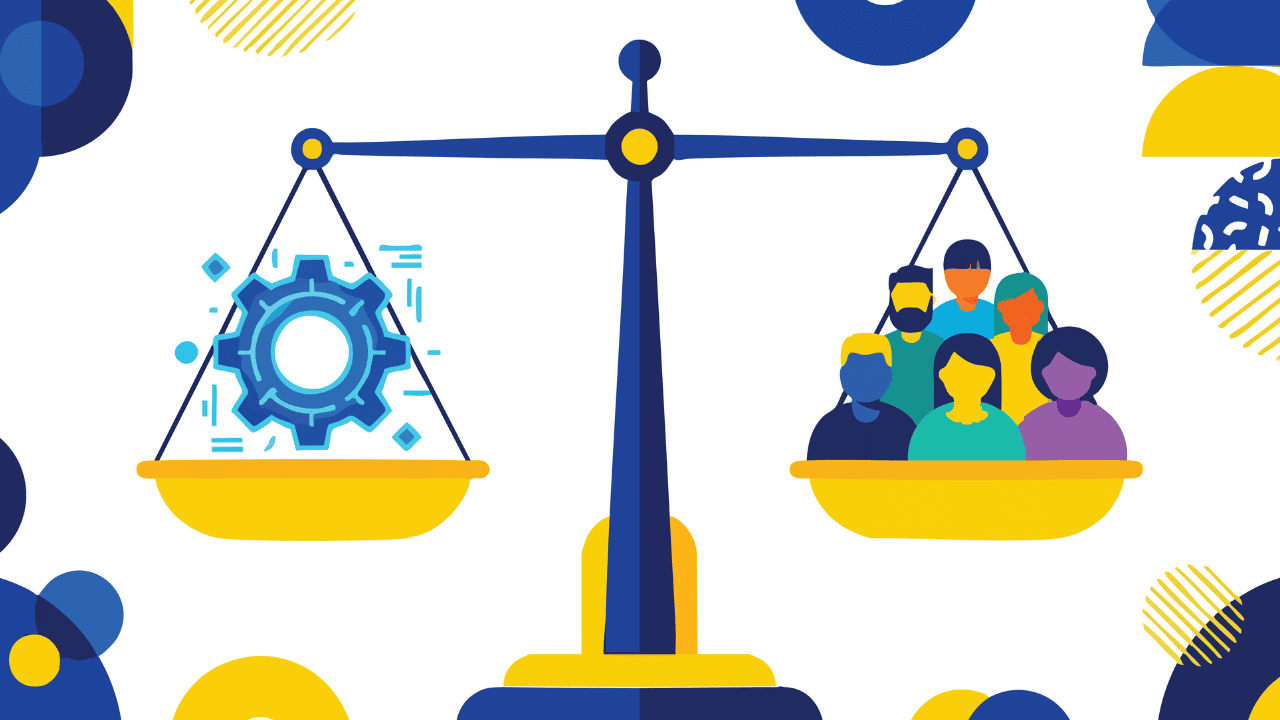
AI has been pushed into customer experience way too fast, faster than anyone should realistically feel comfortable with. Zendesk has even said that AI will soon play in a role in 100% of customer interactions sometime soon, in one way or another.
Elsewhere, Salesforce, NiCE, and countless other companies are telling us that AI is already running the contact centre, while human employees seem to become less and less relevant. The trouble is that business leaders can’t just “slow down”. Their boards are pressuring them to deploy tools faster and scale them quicker than ever before.
So, what do we do? Just sit back and let the bots take over?
That sounds like the efficient choice, but not the most ethical or practical one. Human beings are still necessary in customer service. People still want empathy, human expertise, and real connections. They’re also less willing to forgive AI when something goes wrong (and eventually, it always does).
What we actually need is a different way to approach AI and automation. A people-first approach. Hence, the growing focus on “human-centered automation”.
What is Human-Centred Automation?
Automation is usually mentioned as a replacement story. Machines take over the work, people step aside, and efficiency goes up. But this is not what human-centred automation is trying to do. The routine steps still move to automation, yet the difference is what happens next. The human part of the job stays where it belongs.
Decisions that require context and situations that don’t follow the script need people.
It sounds great, like an ethical way to actually avoid the AI apocalypse. Unfortunately, for a lot of companies right now, human-centred automation is little more than marketing spin.
Leaders say they’re going to build workflows around humans, then they just start automating tasks, ignoring the reality around them. Somehow, they still act surprised when agents get stuck dealing with workslop, and customers are forced to deal with endless robotic dead ends.
The drive to “automate everything” ultimately pushes human-centred automation further and further into the background for a lot of leaders. They’re too concerned about getting tasks done and reducing costs to think about the impact on people.
They also realise that true human-centred automation takes work. The World Economic Forum has always explained that the right approach requires a lot of steps: work redesign, training, and a continued focus on measuring human wellbeing.
That’s a lot of effort nudged towards leaders who are just trying to get board members to stop badgering them for higher containment and deflection rates.
The Benefits of Human-Centred Automation
A lot of analysts and researchers already agree that human-centred automation is the way forward. But if we’re going to get leaders to prioritise it over the glowing appeal of “limitless automation,” we need to present the benefits in a way they can understand.
Fortunately, when you start looking at what human-centric approaches actually do to automation and AI, particularly in the CX space, a lot of advantages really do start showing up.
The argument isn’t that automation and AI shouldn’t exist in CX. It’s going to be here whether we like it or not. It’s more that humans supported by AI are generally more effective, more profitable, and more valuable than bots on their own.
Employee Engagement, Satisfaction, and Retention Rates Increase
A lot of automation projects make work feel thinner. That’s one of the reasons employees push back.
Human-centric automation tends to have the opposite effect when it’s done properly. It strips out the low-value grind without stripping out the part of the job that still feels human. Less copy-and-paste work, jumping between systems, and time wasted writing routine notes or tracking down basic policy details. More time for actual problem-solving.
In customer operations, the small repetitive tasks pile up fast. A few seconds here, a few minutes there, and suddenly an agent’s day is mostly admin with a headset on.
A Stanford and MIT study of 5,179 customer support agents found that a generative AI assistant boosted performance by 14% on average, with the biggest gains among less experienced staff. It also pointed to better customer sentiment and lower turnover. That suggests human-centred AI can help newer employees get up to speed faster without turning them into script-readers.
Another useful proof point comes from Genesys. In its product support operation, the company reported a 43% drop in case escalations, a five-minute reduction in handle time, a 90% increase in scheduled employee development time, and employee attrition kept below 3%. Those numbers connect employee experience to operational outcomes.
There’s another piece of this that often gets overlooked: role design. Gartner found that almost 80% of organisations expect some agents to move into more complex or emotionally sensitive work, and 84% say those roles will need new skills. That lines up with the real promise of human-centric AI in customer operations.
Routine work moves to automation. The harder situations stay with people. Those are the moments that call for patience, judgment, and a bit of context. When the split works that way, employees usually do better in the role and stick around longer.
Performance and Efficiency Improve, AI Workslop Goes Down
Efficiency is the easiest benefit to talk about and the easiest one to fake with AI and automation.
A team can automate half the workflow, brag about speed, then quietly dump the cleanup work onto employees. That still happens all the time. AI-generated summaries need fixing. Routing sends cases to the wrong place. Self-service flows handle the easy bit, then leave the ugly part for a person with none of the right context.
That’s why human-centred automation is more useful as a performance model than as a branding line. It focuses on quality-adjusted efficiency. Not just whether something moved faster, but whether it moved cleanly. When humans stay in the loop and actually work alongside bots, rather than being replaced by them, they perform better.
They spend less time fixing workslop, because AI tools don’t have the capacity to just “do work” without anyone with real human insight getting involved. They also actively play a role in shaping what AI does. Teams with a human-centred approach to automation ask for employee input on AI workflows, processes, and guardrails.
Plus, companies start thinking realistically about how automation can support their people. They don’t just invest in “bots to replace workers”. They look at AI coaching tools that can deliver personalised training in real-time, bots that help with IT issues, and systems that remove everyday frictions from the tasks that real people still have to do.
Customer Experiences Get Better, and Don’t Turn Robotic
Nobody wakes up hoping to deal with more automation. Customers just want their problem solved without jumping through hoops. That’s why human-centred automation works when it removes friction but doesn’t strip the interaction of its human side. Quick triage helps. Smart routing helps. Giving agents the right context from the start helps. Not asking customers to repeat the same information three times definitely helps.
But the real test shows up when the situation stops being straightforward. People are usually fine using AI for simple tasks like checking an order or asking a quick question. Once things shift into complaints, billing issues, or anything emotional, most customers want a person involved.
That’s one of the strongest arguments for human-centric automation in CX. It keeps automation where it adds convenience and keeps people where reassurance, nuance, and judgment matter more.
Look at Verizon’s approach. The company uses generative AI to predict the reason for around 80% of customer calls, route people more accurately, shorten some in-store interactions by roughly seven minutes, and help reduce churn.
That’s a solid example of human-centred AI being used to smooth the path rather than force customers into a fully automated experience they never wanted in the first place.
There’s also a warning tucked into this benefit. AI doesn’t fix a broken service model. If the workflow is messy, the data is incomplete, or systems barely connect, customers will still run into the same problems. Automation just gets them there quicker.
Trust, Transparency, and Brand Credibility Strengthen
A lot of AI discussions treat trust like a soft issue. It isn’t. Trust is what determines whether customers accept automation, whether employees use it properly, and whether a brand gets the benefit of the doubt when a process misfires.
That’s one reason human-centred automation matters so much. It gives companies a better chance of keeping accountability visible. Customers can tell when a business is hiding behind the machine. They can also tell when the automation is there to make the experience easier, while a human remains reachable and clearly responsible for the outcome.
With a human-centred automation approach, companies ensure:
- Customers get a clear path to a human
- They know when AI is being used and why
- The human touch doesn’t disappear just because the brand wants to cut costs
Privacy and governance sit inside this, too. 95% of organisations said privacy is the foundation of customer trust in AI-powered services, yet only 12% said their AI governance frameworks were mature. That gap says more than most strategy decks do. Lots of companies want customers to trust AI. Far fewer have done the slow work required to deserve that trust.
At least with a human-centred approach, you’re showing your customers that you’re not just blindly trusting AI to make every decision for you.
Compliance, Governance, and Security Improve
Speaking of privacy, governance, and compliance, those are three things that essentially guarantee bots can’t replace humans completely yet.
As soon as AI starts touching customer data, service decisions, financial information, complaints, identity checks, or regulated workflows, the question changes. It stops being “Can this be automated?” and becomes “Who’s accountable if this goes sideways?”
Human-centred automation forces companies to define where automation is appropriate, where a human needs to review, and where the process needs tighter controls.
That’s becoming more important as regulatory pressure continues to mount. Recently, regulators in the UK reminded companies that consumer law still applies to AI agents. Various other guardrails come into question with AI and automation, too.
If an AI system gives misleading information, buries key terms, or creates an unfair experience, the fact that software was involved won’t save the business. Keeping humans in the process is how you ensure your strategy builds in:
- Clearer ownership of decisions
- Stronger audit trails
- Tighter control over sensitive data
- Review points for risky or ambiguous cases
- Fewer “the system did it” excuses
Innovation and Human Creativity Evolve
Automation often gets framed with a tidy story: remove the routine tasks and everything else somehow improves on its own. That isn’t how it plays out. Freeing up time only matters if the organisation actually knows what it wants people to do with that time.
This is where human-centred automation can get genuinely interesting. When repetitive work drops away, teams have more room for the things AI still struggles with: judgment, creativity, emotional reading of a situation, practical problem-solving, knowing when the rulebook fits and when it doesn’t.
The World Economic Forum has been pointing out something that gets lost in the hype. AI doesn’t just speed things up. It changes what work looks like. Leaders need to redesign work so people can focus more on creativity, emotional intelligence, and higher-value problem-solving.
In CX, that can mean more time spent on:
- Resolving unusual or high-stakes cases
- Improving service design and personalisation
- Coaching and mentoring newer staff
- Spotting journey failures before they spread
- Having better retention and recovery conversations
Human-centred automation gives businesses a chance to use AI for scale without flattening the human part of service into something mechanical. A lot of brands say they care about empathy, judgment, and relationships. Human-centric AI is one of the few ways to prove it.
Adoption Rates Climb for New Tech
A lot of AI rollouts fail long before the technology does. The tool may work well enough. The real problem is that employees don’t trust it, don’t need it, or can already tell it’s about to make their job more annoying.
That’s where human-centred automation has an edge. It is easier to get real adoption when the system clearly helps people do the work. Faster prep. Better context. Less admin. Cleaner handoffs. Fewer pointless clicks. Those things matter more than a grand vision deck about transformation.
Service leaders tend to see both sides of AI at the same time. The advantages are hard to ignore. Faster processes. Better access to information. Less repetitive work for teams. Those gains are real. But there’s hesitation too.
Trust can slip if automation goes too far. Privacy concerns are still there. And customer interactions get delicate once machines start making decisions inside them. That tension isn’t necessarily a problem. In fact, it usually slows organisations down just enough to ask better questions before deploying the next system.
Discovering the Advantages of Human-Centred Automation
The argument for human-centred automation isn’t that it sounds nicer. It’s that it actually works better.
Companies can automate aggressively and still end up with worse service, weaker trust, and employees stuck fixing problems the technology created. Plenty already have. Human-centred automation brings some discipline back into the AI conversation. It forces leaders to think about where automation helps and where human skill still needs to lead.
None of this happens automatically. Leadership teams have to decide what success looks like first. Customer operations then need a redesign so AI supports the expertise people already bring to the job instead of trying to replace it. Governance, training, and performance metrics all need another look. The companies that take that seriously will end up in a different place.
They’ll scale automation without losing the human judgment that makes service work in the first place. That’s what will separate them from the organisations still trying to automate everything in sight.