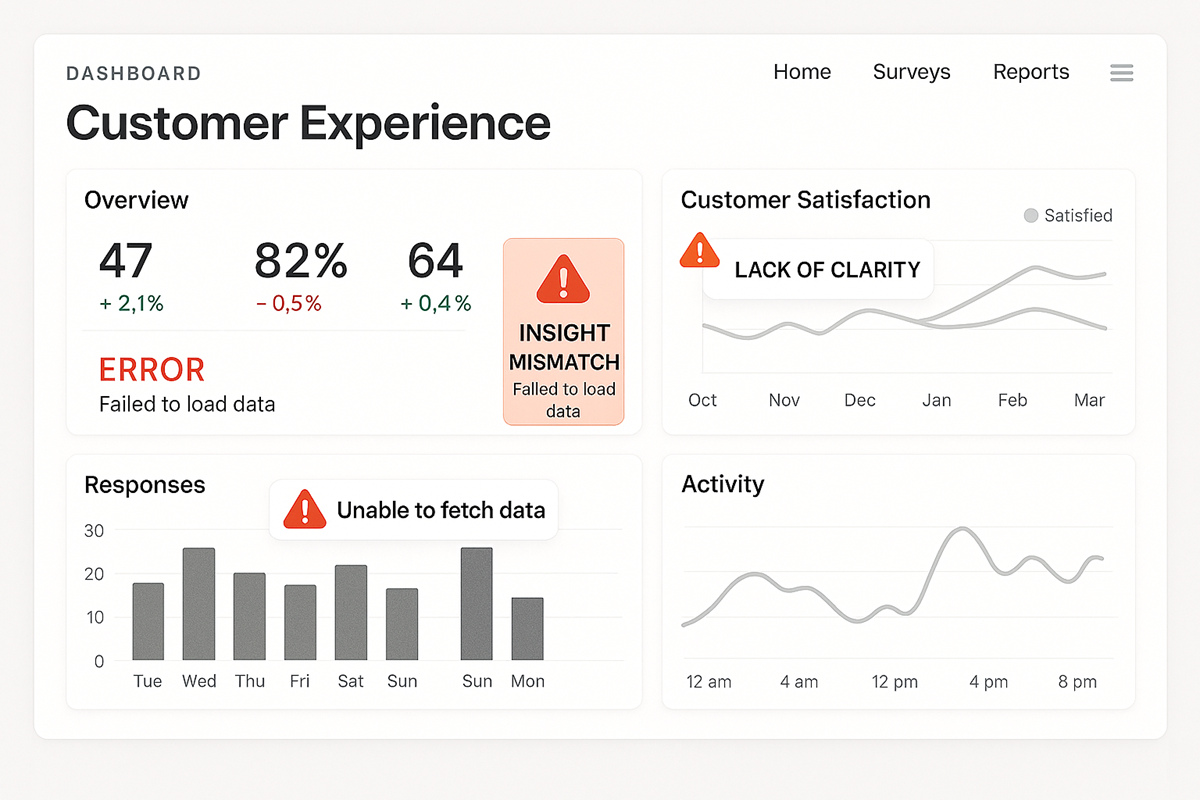
A quick look at LinkedIn and the customer experience forums since the new year has seen a sizeable backlash against the humble CX dashboard.
What has the poor customer experience info-hub screen done to deserve the sudden hate? And what’s the solution as 99.2% of CX leaders, according to our dashboard, are probably currently glued to theirs?
Duris of m4 Communications notes, the problem is “Not because the data is wrong—its because you’re measuring activity, not impact. Most CX teams present metrics. Executives want business cases.
Here’s what I’m seeing: CX teams obsessing over dashboards while missing the actual work. The work is understanding WHY metrics change, not just THAT they changed.
Here’s the problem: CX teams present: “NPS is 42, CSAT improved 3 points, CES is stable.” And executives think: “I have no idea what to do with this information.”
The disconnect is that metrics tell you something changed. They don’t tell you why it changed, what it means for the business, or what to do about it.
That requires empathy and curiosity – looking under the numbers to understand the customer’s actual experience.
Compare these two approaches, one is a metric. One is a business case: Compare “Our NPS dropped 5 points this quarter.” to “Our NPS dropped 5 points. We investigated and found that customers who contact support wait 3+ days for responses. This impacts 2,000 customers monthly and correlates with 15% higher churn. We’re implementing [solution] to recover an estimated $400K in annual revenue.”
A Focus on the Reality Is Needed
Duris concludes, “The reality is that the metric isn’t the story. The action you take because of it is.
If you can’t translate your CX metrics into business outcomes and concrete next steps, you’re not doing CX strategy – you’re doing CX reporting.
What story are your metrics actually telling? Drop a metric you’re wrestling with below—I’ll help you decode the business case.”
A similar refrain comes from Zack Hamilton, the host of Host of Unf*cking Your CX, in video form.
Hamilton’s key takeaways include: Customer experience didn’t fail; the model needs to change. Experience management has limitations in execution and CX leaders must link insights to business outcomes.
Defending the CX Dashboard
There are no Google results for the above heading, so we suspect this is an open and shut case, and CXM vendors are adding greater insights for dashboards with their recent AI powers.
When it comes to customer centricity and a CX-first playbook, we’ve noted that “teams get lost in charts and dashboards, arguing over which metric matters. The truth is, you don’t need a hundred KPIs; you need a few that customers actually feel. Start small.”
With a pretty conclusive set of results from these and other expert articles, we’re keen to hear from anyone defending their current use of a CX dashboard, or real-world examples of how they are doing it right.