July 13, 2026
UKEXA 2026 Live Poll: 119 EX Leaders Share Biggest Blockers to Employee Experience

At the UK Employee Experience Awards (UKEXA) 2026 ceremony on 9 July, attendees took part in a live poll exploring where employee experience stands today. The session drew 119 poll participants and generated 397 responses across three questions. The results offer a candid snapshot of what is working, what is missing, and where AI currently fits into the picture.
The Basics Still Come Before AI
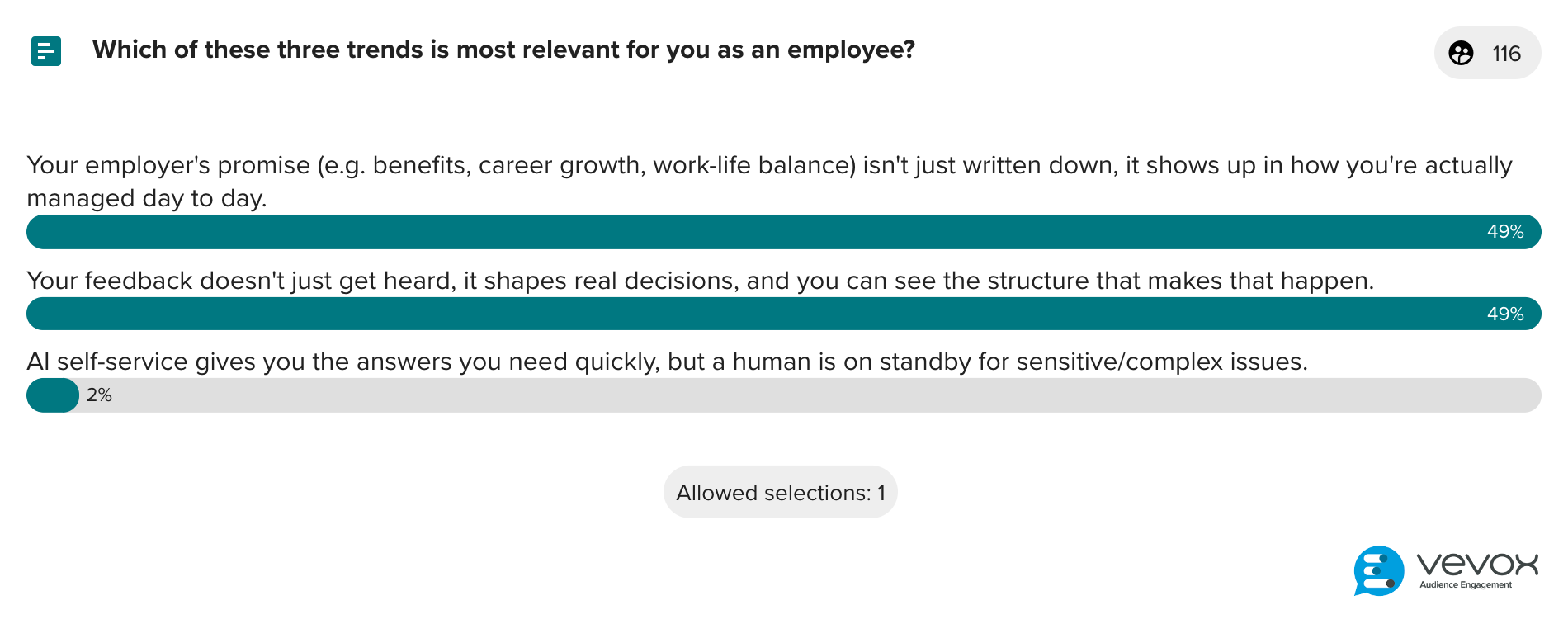
Asked which of three workplace trends felt most important to them personally as employees, attendees split almost evenly between two options. Forty-nine percent want to see their employer’s promises on benefits, career growth, and work-life balance show up in how they are actually managed day to day. Another 49% want to see their feedback visibly shaping real decisions, rather than disappearing into a survey.
Only 2% chose the third option: AI self-service backed up by a human for anything sensitive or complex. That result is easy to misread as a rejection of AI, but the more useful interpretation is one of priority. Attendees are telling us that a well embedded employee value proposition and a genuine listening mechanism are the fundamentals, the things that have to work before anything else does.
AI self-service still has real value as a supplementary layer: it can save time, remove friction, and help employees get accurate information and support faster. But this data suggests organisations that jump to AI integration in EX without first getting the fundamentals right risk disengaging and demotivating people.
Budget and Leadership Are the Real EX Blockers
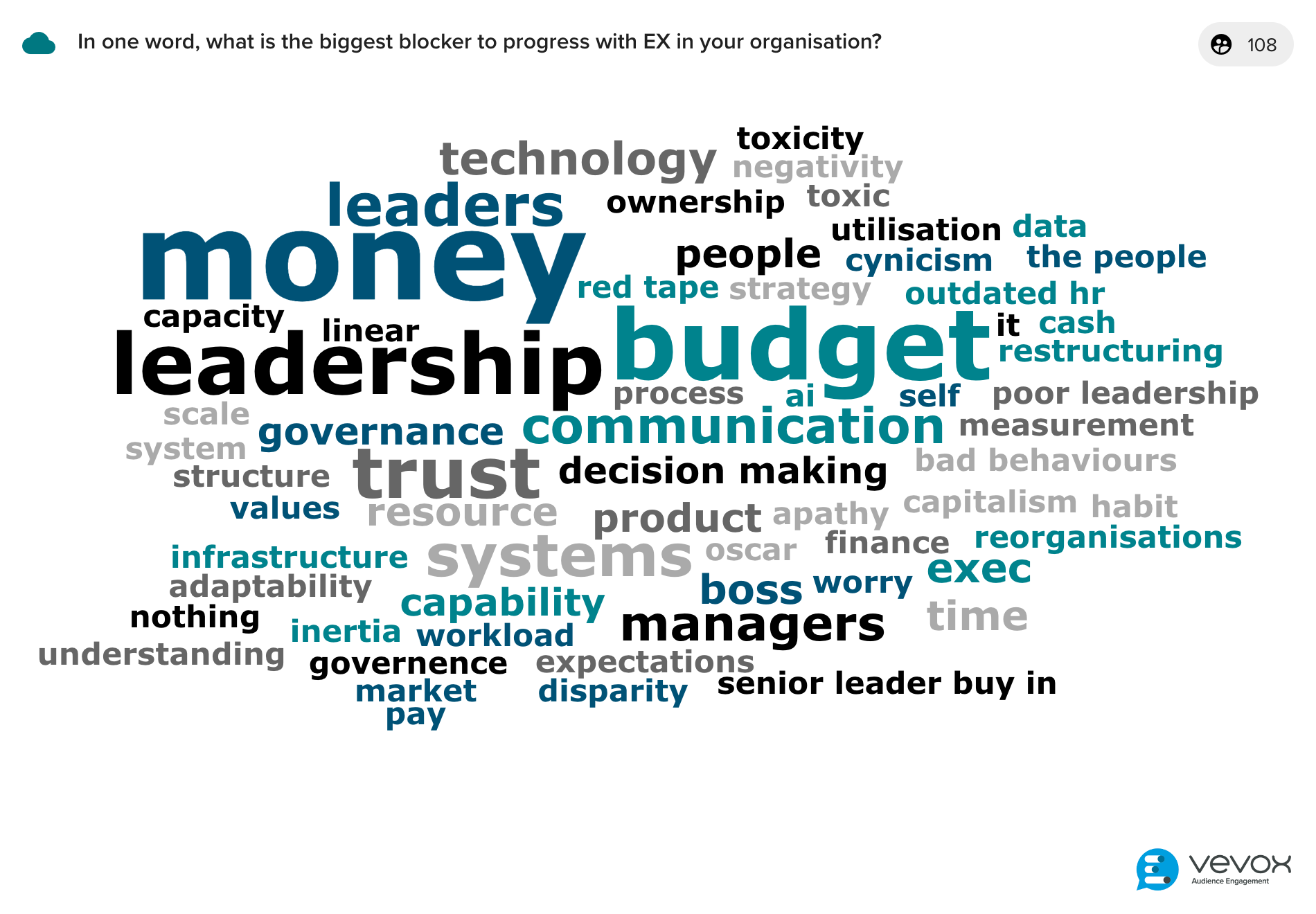
When asked, in one word, what is the biggest blocker to progress with EX in their organisation, two themes dominated the word cloud: money and leadership. Variations on “budget,” “money,” “cash,” “resource,” and “finance” formed the largest cluster of responses, closely followed by “leadership,” “leaders,” “exec,” and “senior leader buy in.”
A third, smaller cluster pointed to managers specifically, distinct from senior leadership, alongside mentions of “workload” and “capacity.” Attendees also cited systems and technology maturity, bureaucracy (“red tape,” “outdated HR,” “restructuring”), and a cluster of trust-related terms including “cynicism,” “apathy,” and “toxicity.”
Read together, the responses suggest EX professionals already have a strategy and the appetite for change; what they lack is the budget and senior mandate to act on it.
Where AI Loses Trust
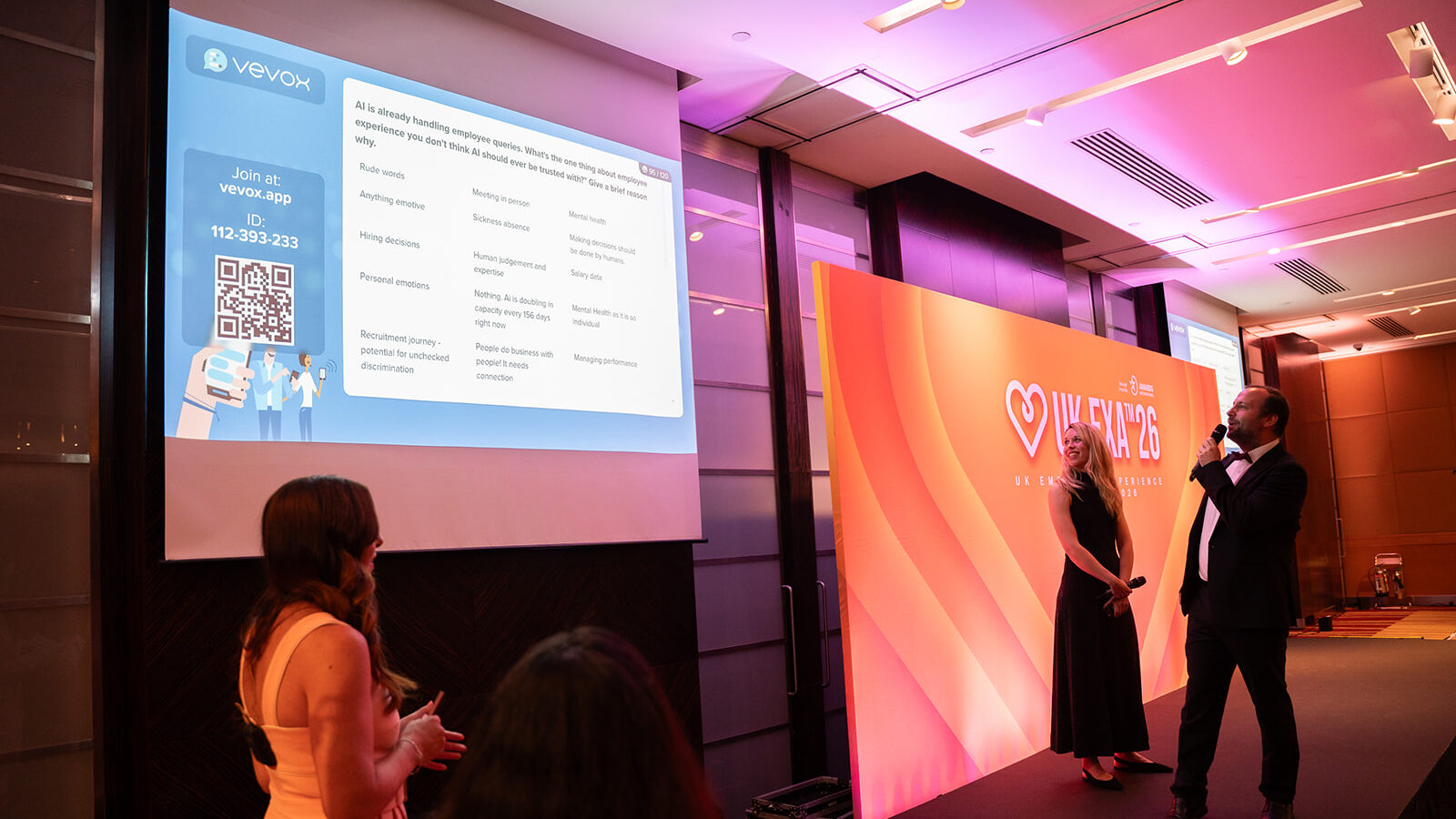
The final open-text question asked attendees the one thing about EX they would never trust AI with, and why. Read alongside the earlier finding on AI self-service, this question starts to explain that 2% figure. It points to where the limits of AI-driven self-service sit, and why a layer of human empathy still needs to be built into any sensitive or nuanced issue.
The largest theme was empathy and human connection. Respondents described AI as having “zero empathy,” noted that it “tells you what you want to hear,” and argued that situations requiring genuine understanding still lack an algorithm capable of properly mimicking human empathy. Closely related was a large cluster around mental health and wellbeing, with many respondents naming it directly as the one area AI should stay out of.
A second, more governance-minded theme centred on high-stakes people decisions: performance management, hiring and firing, and salary decisions. Several respondents raised bias risk explicitly, with one noting that AI “will never be perfect at mitigating bias” in pay decisions.
Employee relations, grievances, and confidential or sensitive personal data formed a related cluster, alongside a smaller but emotionally direct group of responses about bereavement and crisis moments, where attendees were explicit that these require a human presence in the room.
A small minority pushed back on the premise entirely. One respondent argued that trust in AI is only a matter of time, pointing to the pace at which AI capability is compounding. That view was rare in the data, but it stands as a live counterpoint inside a room otherwise sceptical of automation’s limits.
The Throughline
Taken together, the three questions tell a consistent story. UKEXA attendees want the fundamentals in place first: a genuinely embedded employee value proposition and a listening mechanism that visibly acts on what people say, delivered largely through managers and structural feedback loops. They see budget and leadership buy-in, rather than a shortage of ideas, as the real gap between ambition and delivery. And their appetite for AI is only supplementary to EX fundamentals.