January 08, 2026
OpenAI Launches ChatGPT Health With Medical Record and Wellness App Integrations
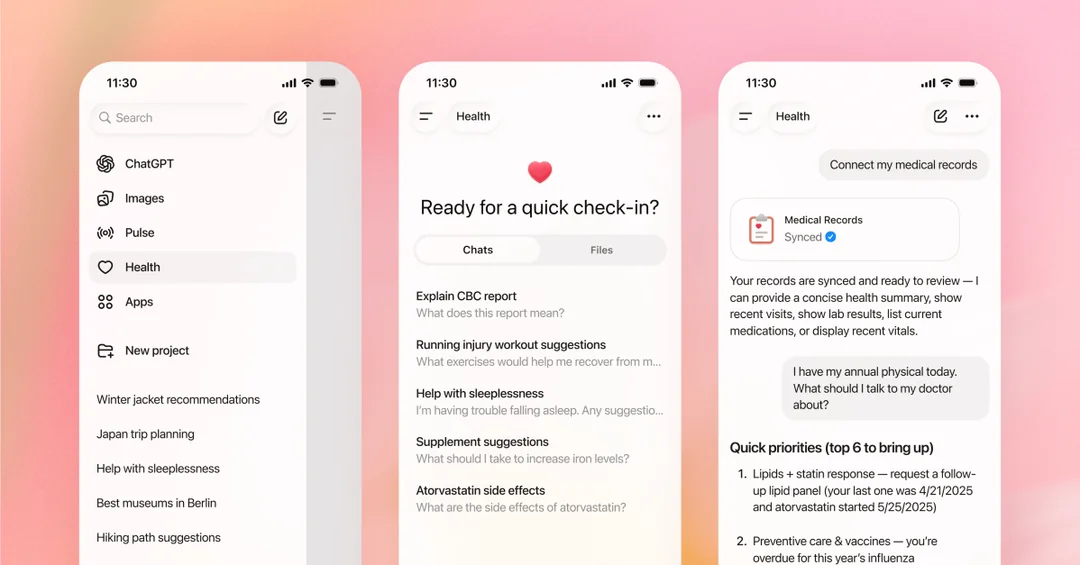
OpenAI has launched ChatGPT Health, a new dedicated health experience inside ChatGPT that allows users to ask health-related questions in a separate environment and optionally connect medical records and wellness apps for more personalised responses.
The release reflects behaviour that was already common on the platform, with health and wellness questions among the most frequent reasons people use ChatGPT. OpenAI says more than 230 million users ask these questions each week, and ChatGPT Health simply moves them into a separate space with additional privacy and security controls.
At launch, Health appears as a sandboxed tab within ChatGPT, with its own chat history, memory system, and data boundaries. These conversations stay separate from the rest of a user’s chats, and OpenAI says the information shared won’t be used to train its foundation models.
What ChatGPT Health Actually Does
ChatGPT Health allows users to connect personal health data to ground conversations in real context rather than generic advice. In the U.S., users can link medical records through a partnership with b.well, which connects to a host of healthcare providers and enables access to lab results, visit summaries, and clinical histories. On the wellness side, integrations include Apple Health, MyFitnessPal, Function, and other fitness and nutrition platforms.
OpenAI suggests these connections can help users better understand test results, prepare for appointments, review trends in sleep or activity, or think through diet and exercise choices. The company is careful to state that users should not use Health for diagnosis or treatment but as support for clinicians.
All integrations are opt-in, require explicit permission, and can be removed at any time. Apps connected within Health do not automatically gain access to health data simply because they are used elsewhere in ChatGPT.
Built With Guardrails — On Paper
OpenAI has leaned heavily on safety and governance in describing Health. The company says the feature was developed with input from more than 260 physicians across dozens of specialties and countries, and that responses are evaluated using HealthBench, an internal framework that prioritises clarity, appropriate escalation of care, and safety over simplistic accuracy checks.
That said, the experience still relies on users interpreting AI-generated explanations correctly and knowing when to defer to professional care, a familiar challenge for AI tools operating in high-risk sectors.
The app is currently rolling out via a waitlist and is available only to users outside the European Economic Area, Switzerland, and the UK. Medical record integrations and some app connections are only available in the U.S., and Apple Health requires iOS. OpenAI says it plans to expand access gradually across subscription tiers and platforms.