July 09, 2026
Slackbot Can Now Run Your CRM Thanks to New Salesforce MCP Servers
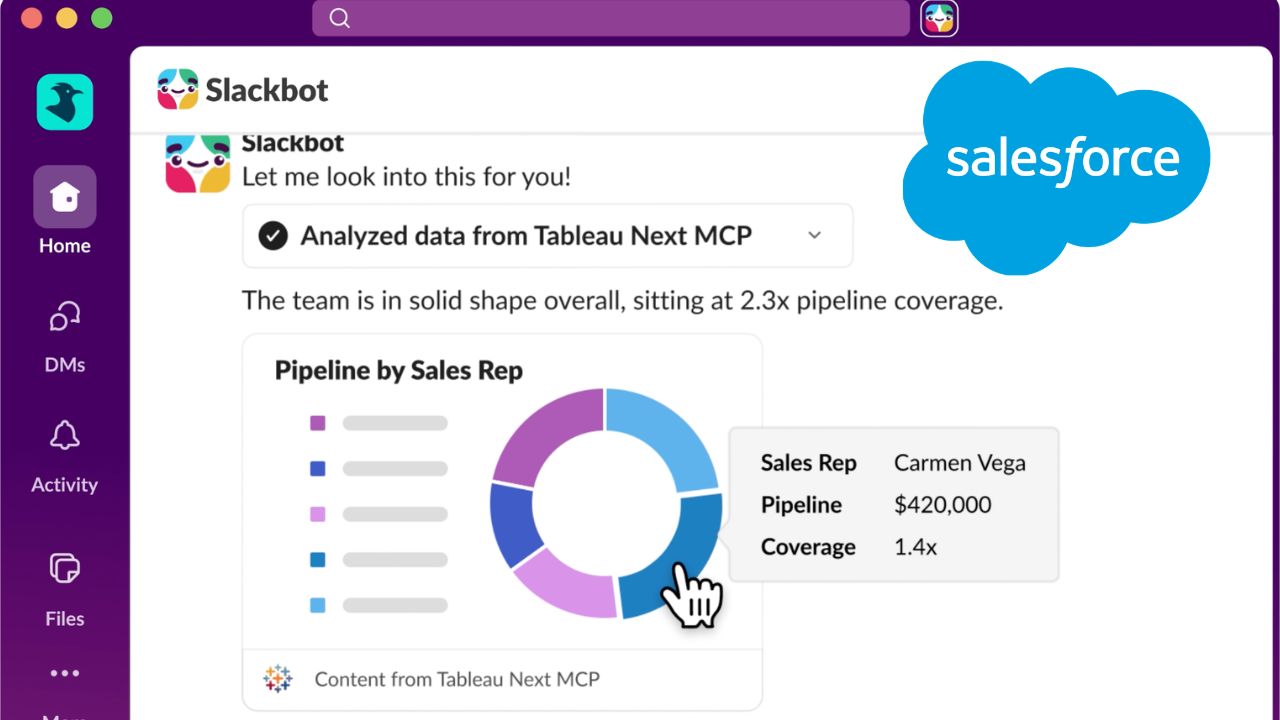
Salesforce has switched on a set of dedicated Model Context Protocol (MCP) servers that connect Slackbot, its AI agent built into every Slack workspace, directly to CRM records, Tableau analytics, Data 360 customer profiles and Agentforce agents.
Users can now ask Slackbot about a customer, and it pulls the full record. They could ask it for a trend, and it renders a live chart. Additionally, they could request it to kick off a workflow. It coordinates with whichever connected app owns the next step, whether that’s Jira, Box or DocuSign.
The tweak in the underlying mechanics is fairly significant. Slackbot has been able to read and write Salesforce records for a while, but only in a relatively shallow manner. These new servers give it a native understanding of an organisation’s own custom objects, fields, and Flows. It executes this without anyone needing to write integration code. A sales rep can update pipeline data based on the day’s calls and approve the changes in a single click. A service agent, in theory, can route a case without opening a second application.
Salesforce is also opening the door wider than just its own tools. A growing list of MCP-native partner apps, including Atlassian, Zapier, Jira, Box, DocuSign and Lattice, can now act inside the same Slack conversation. They draw on the same customer context Slackbot has.
In an interview with SiliconANGLE, Slack CMO Ryan Gavin summed up the thinking behind the whole build:
“Slackbot can now reason over your entire Salesforce platform, so anything you can do in Salesforce, you can simply now do through Slackbot, just by asking (…) Work is a multiplayer sport.”
It’s a tidy line, and not an inaccurate one. What’s mechanically changing is fewer tabs and less re-explaining yourself to five disparate tools that don’t talk to each other.
Five Years in the Making For Salesforce and Slackbot
None of this happens in isolation. Salesforce bought Slack for $27.7 billion in 2020, but the two products have taken a long time to feel like they belong to the same company. This announcement suggests the merger is decisively being built for, rather than just accounted for on a balance sheet.
It also puts Salesforce in more direct competition with Microsoft. The Redmond giant has been making a similar bet that AI orchestration should sit inside the collaboration tools people already use daily, not bolted onto a separate assistant.
Salesforce hasn’t said whether this requires a new licence tier. Reporting so far points only to Business+ and Enterprise+ plans. That’s worth remembering before anyone gets too excited on a sales call.
What the MCP Servers Mean for the People Using Them
For anyone working in a service desk or a sales pipeline, there is tangible upside. There will be fewer logins and dashboards. In theory, a customer history will turn up the instant you ask for it rather than after three minutes of searching. Salesforce also says permissions carry over automatically. This means a coordinator can’t accidentally see data they’re not cleared for, and admins can switch capabilities on without writing any code.
That’s the reassuring version. The version that is less so is that an AI agent now has standing access to edit live customer records from inside a chat window. Meanwhile, nobody but a few people outside Salesforce has stress-tested what happens when the agent gets something wrong. For teams already leveraging Slack, this is arguably worth trying on a small scale first, ideally with someone from security in the room, before it becomes the default way anyone touches a customer record.